
Vehicles and mobility · Discovery
Design referenceCitroën DS
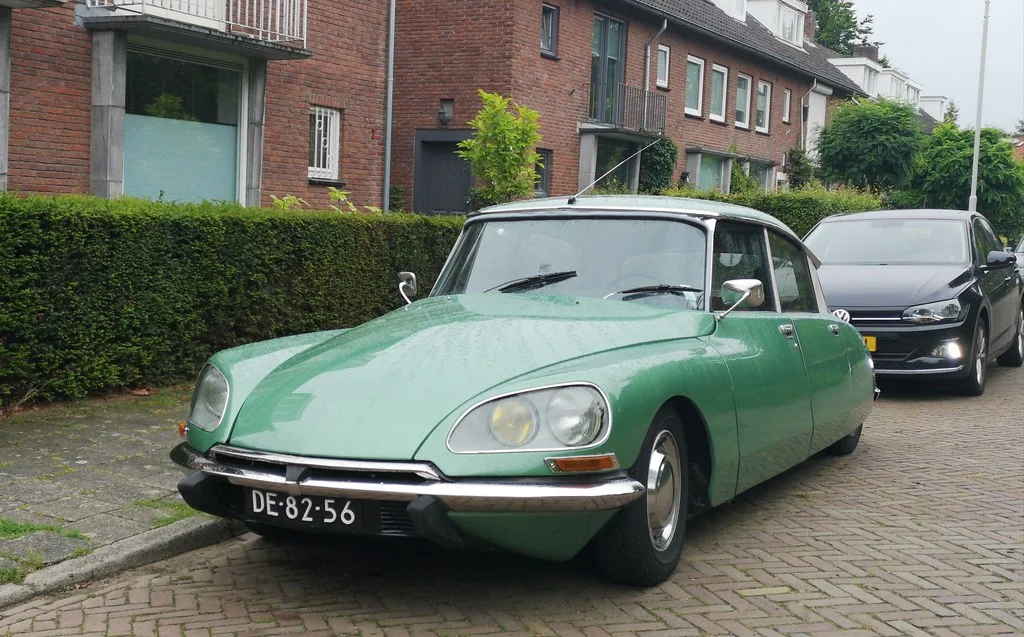
A car whose long body and floating roofline make the road look almost liquid.
Summary
A car whose long body and floating roofline make the road look almost liquid.
Reading status
A vehicle design reference and visual reading, not a model authentication, safety check, appraisal, or mechanical report.
At a glance
A long aerodynamic car with a low nose, tapered rear, thin roof supports, and unusually smooth surfaces.
- Design lineage
- Citroën
- Period
- 1955 onward reference
- Materials
- Steel, glass, composites, systems
- Setting
- Vehicle design reference
Visible evidence
Why it matters
The DS makes a vehicle feel like an argument about shape. Its body seems to move forward even in a still photograph, while its details resist ordinary car categories.
Visible evidence
Look closer
Three details to carry with you.
- 01
Follow the roofline and notice how little it weighs visually.
- 02
Compare the smooth body with the sharp openings for lights and wheels.
- 03
Look at the front and rear as different kinds of motion.
Documented context
How it was made
Painted body panels · Glass and rubber · Mechanical and hydraulic systems
Documented context
Story and context
The DS was introduced in the 1950s and became known for its distinctive aerodynamic form and technical ambitions.
Documented context
Culture and context
It is often described as futuristic, but that impression comes from a precise mix of familiar car parts and unfamiliar relationships between them.
Documented context
Honest facts
Keeping certainty visible.
- A photo cannot verify model, year, originality, working systems, safety, condition, or value.
- The page is not a mechanical or engineering assessment.
Interpretation
Interpretation
One way to read it.
The car seems to float because its body hides the usual visual evidence of weight.
Another reading
The smoothness can feel uncanny rather than graceful. The car may look less like a machine than a shell adapted to motion.
This example follows the same order as an Art Says Hi result. Visible details come first, documented context comes next, and interpretation stays clearly marked.
Take another look
Which line makes the car look most futuristic: the roof, the nose, the sides, or the rear?
Upload a photoSources
Follow the sources, then return to the image. Some links lead to a collection or publisher website.
Image credits
Citroen DS 21
crash71100 (opens in a new tab)CC0 1.0 (opens in a new tab)
Resized and converted to WebP for local delivery; composition otherwise unchanged.