
Vehicles and mobility · Flagship
Design referenceClassic Mini
A small car that makes economy, character, and crowded urban movement share one shape.
Summary
A small car that makes economy, character, and crowded urban movement share one shape.
Reading status
A vehicle design reference and visual reading, not a model authentication, safety check, appraisal, or condition report.
At a glance
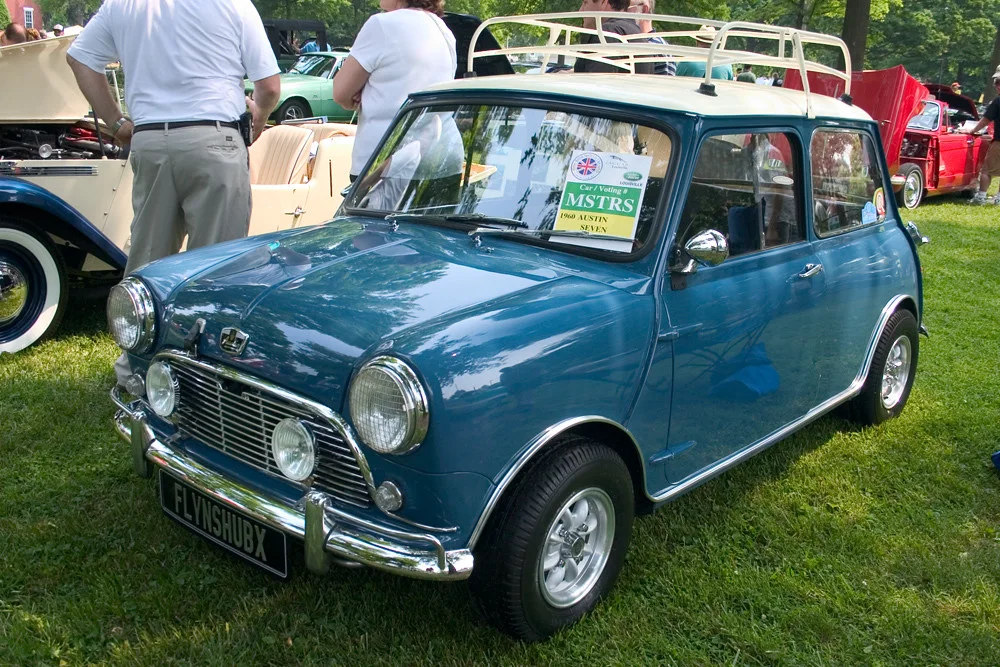
A compact car with a short bonnet, upright cabin, small wheels, and a boxy body softened by rounded details.
- Design lineage
- BMC and Mini
- Introduced
- 1959 onward reference
- Materials
- Steel, glass, rubber, systems
- Setting
- Vehicle design reference
Visible evidence
Why it matters
The Mini is visually interesting because the small footprint is not hidden. The car makes a design challenge visible: how to keep people inside while leaving room for movement around them.
Visible evidence
Look closer
Three details to carry with you.
- 01
Compare the short bonnet with the tall cabin.
- 02
Notice how the wheels and corners organise the car's stance.
- 03
Look at the contrast between the boxy body and rounded lamps or trim.
Documented context
How it was made
Painted steel body · Glass and rubber · Compact mechanical systems
Documented context
Story and context
The Mini was introduced in 1959 and became a lasting reference for small-car packaging and British popular culture.
Documented context
Culture and context
It can stand for economy, rebellion, nostalgia, or city life depending on the image around it. The shape is stable while the story keeps changing.
Documented context
Honest facts
Keeping certainty visible.
- A photo cannot verify year, edition, originality, safety, condition, or value.
- This is design history and visual analysis, not buying, driving, or mechanical advice.
Interpretation
Interpretation
One way to read it.
The car feels lively because it does not apologise for being small. Proportion becomes personality.
Another reading
The compactness can also read as constraint. The same economy that makes the car memorable can make the body seem tightly packed.
This example follows the same order as an Art Says Hi result. Visible details come first, documented context comes next, and interpretation stays clearly marked.
Take another look
Does the Mini look more like a clever container or a playful character? Let the proportions decide.
Upload a photoSources
Follow the sources, then return to the image. Some links lead to a collection or publisher website.
Image credits
Classic Mini
The Pug Father (opens in a new tab)CC BY 2.0 (opens in a new tab)
Resized and converted to WebP for local delivery; composition otherwise unchanged.