
Architecture and places · Flagship
Documented placeThe Pantheon, Rome
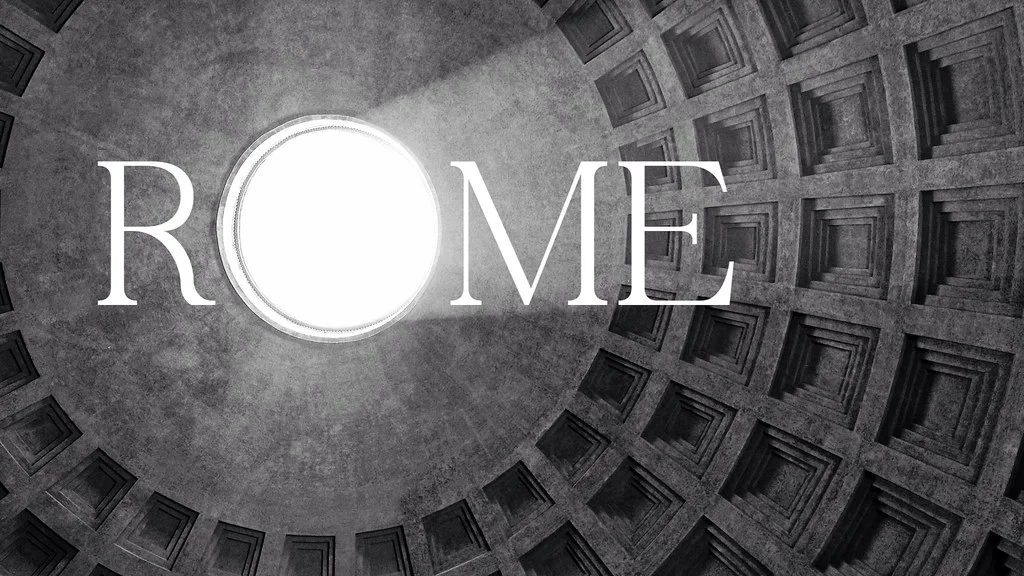
A room whose most important window is a circle cut into the sky.
Summary
A room whose most important window is a circle cut into the sky.
Reading status
A documented historic building. The page uses geometry and light for looking, not as an engineering or conservation report.
At a glance
A monumental portico leads into a domed interior organized around a central opening.
- Built
- c. 125 CE rebuilding
- Materials
- Concrete, brick, stone, marble
- Setting
- Rome, Italy
- Subject
- Dome with central oculus
Visible evidence
Why it matters
The Pantheon makes geometry feel atmospheric. The oculus is not just a hole in the roof; it turns time, weather, and light into part of the room.
Visible evidence
Look closer
Three details to carry with you.
- 01
Find the circle of the oculus before trying to name the building's function.
- 02
Compare the heavy entrance with the apparently weightless dome.
- 03
Notice where light lands on the floor and how it turns the room into a clock.
Documented context
How it was made
Roman concrete · Marble and stone facing · Dome and oculus
Documented context
Story and context
The present building is associated with Hadrian's rebuilding in the second century CE and sits on the site of earlier structures.
Documented context
Culture and context
The Pantheon has carried different religious and civic meanings across time. Its visual power comes partly from how easily the geometry survives those changes.
Documented context
Honest facts
Keeping certainty visible.
- Dates and building history need architectural and archaeological sources; a photograph cannot verify every phase.
- The reading does not evaluate current building safety, access, or conservation condition.
Interpretation
Interpretation
One way to read it.
The dome feels calm because the oculus makes the outside world enter without breaking the room's enclosure.
Another reading
The opening can feel less like a window than a reminder that the room is never fully sealed from time or weather.
This example follows the same order as an Art Says Hi result. Visible details come first, documented context comes next, and interpretation stays clearly marked.
Take another look
Does the oculus make the room feel more open or more controlled? Watch what the moving light does to your answer.
Upload a photoSources
Follow the sources, then return to the image. Some links lead to a collection or publisher website.
Image credits
Pantheon - Rome, Italy
derekskey (opens in a new tab)CC BY 2.0 (opens in a new tab)
Resized and converted to WebP for local delivery; composition otherwise unchanged.