
Guide · Sculpture
How to look at sculpture from every side
Change your position, and a form can change its meaning. Start with silhouette, space, and material.
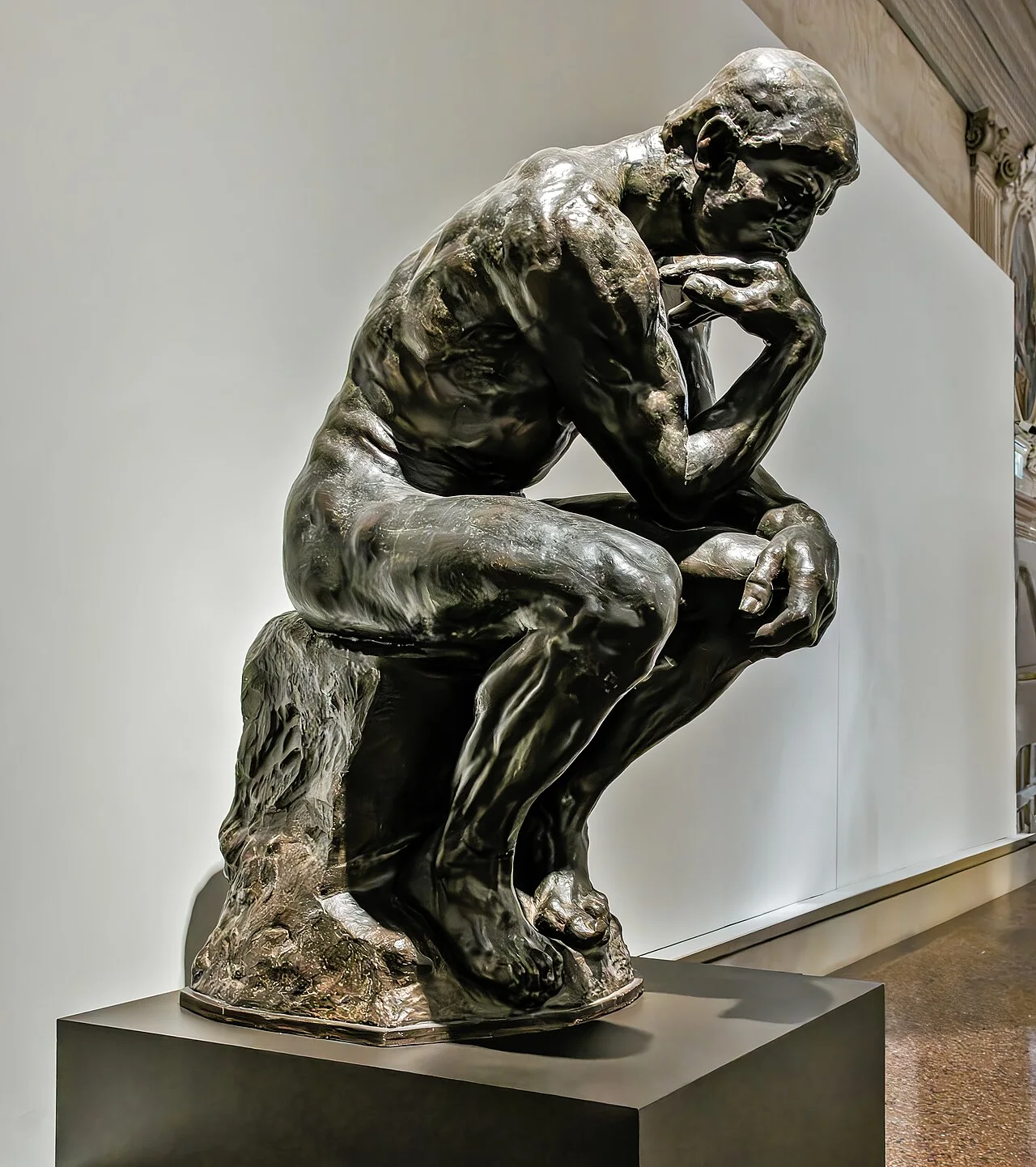
A photograph can introduce a sculpture, but it has already chosen where you stand. Three-dimensional work often changes as you move: a form that seems compact from the front may open into gaps and diagonals from the side. The Metropolitan Museum of Art makes this point in its account of seeing a bronze sculpture in 360 degrees (opens in a new tab). You can use the same habit with a work in a gallery, a public place, or several photographs of one object. Always follow the site's viewing rules and keep a safe distance.
Start with the outline
Before naming a subject, look at the outer edge of the form. Where does its weight seem to gather? Which line leads your eye back into the work? Notice whether the sculpture rises, leans, folds, or spreads. These are observations about the form in front of you. They do not require a theory about what the artist meant.
Look through the sculpture as well as at it. A space between an arm and a body, between two figures, or beneath an overhang can shape the whole composition. From another position that opening may narrow or disappear. A single photograph cannot show every side of a three-dimensional work; the Met's 360-degree example shows how a walk around one bronze reveals details hidden in a standard still image.
- Viewed from the front
- Viewed from the side
- Viewed from behind
Try this in three steps
Choose a first position. Spend a moment on the silhouette, the apparent balance, and one small detail. Describe what you can see without guessing how the object was made.
Change your angle if you can. Move to a permitted side view or compare another photograph. What happens to the outline, the gaps, and the relationship between parts? If you cannot move, say what the photograph leaves unknown.
Look again at the surface. Follow highlights and shadows across the material. Ask whether a mark belongs to the object, the light, or the photograph. Use a collection record before naming a material, process, date, or edition as fact.
From the front
From the side
Test the method with The Thinker
In the Art Says Hi reading of The Thinker, the bent body gathers the head, arm, and legs into a compact shape. Trace that diagonal in the credited photograph. Then ask which parts of the pose the camera makes easy to see, and which are concealed by its viewpoint. The Musée Rodin record (opens in a new tab) supplies the documented work context; the image itself supplies only visible clues from one angle. Neither should be replaced with a confident story about the sitter's thoughts.
Is the bright edge part of the material, or just where the light falls?
Highlight
Is the line a casting seam, a join, or a fold in the form?
Line across a form
Is the dark area a shadow in the room, or a mark in the photograph?
Shadow
What a picture leaves open
Scale, depth, the back of a work, and its relationship to the room can be difficult to judge from one image. A close-up may help you see texture while hiding the sculpture's full outline. A distant view may do the opposite. The useful response is to name the limit, seek a second view or an institutional record, and keep your interpretation separate from what you observed.
Take another look
Which angle changed your first impression, and what visible detail caused the change? If you have your own photo of a sculpture or object, you can start a browser reading and choose when to submit it.
Sources
The three-step exercise is Art Says Hi editorial guidance, not an institutional quotation.
Read a photo of your ownYour photo is only sent when you choose Start reading.
Spotted an error? Tell us