
Art and sculpture · Flagship
Documented artworkThe Thinker
A body at rest that still carries the pressure of a thought in motion.
Summary
A body at rest that still carries the pressure of a thought in motion.
Reading status
A documented sculpture example. A photo can support visual observations, but not identify which cast or verify condition.
At a glance
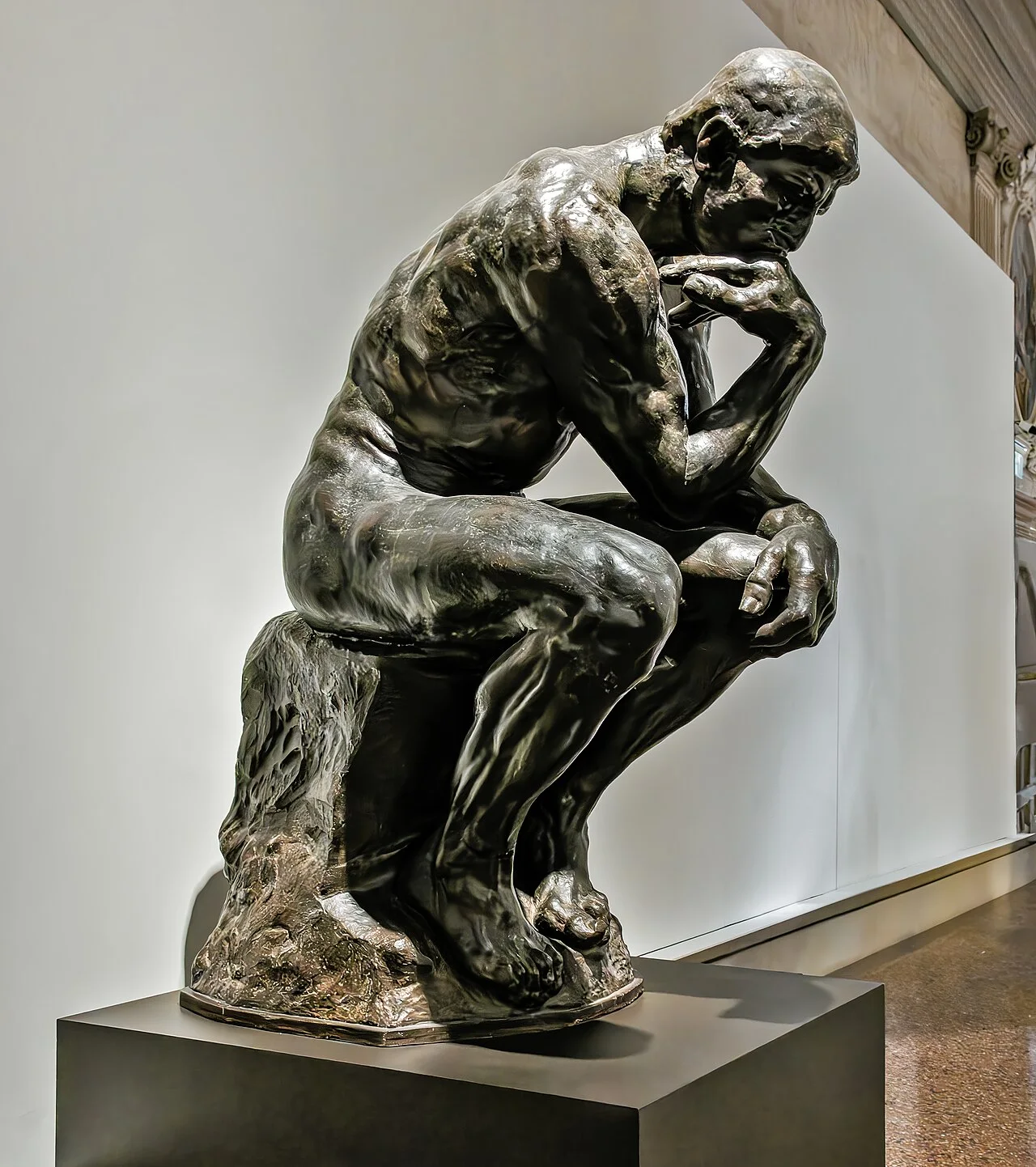
A seated, muscular figure folds inward, balancing a heavy head on one hand.
- Made by
- Auguste Rodin
- Made
- 1904 cast
- Medium
- Bronze
- Setting
- Musée Rodin, Paris
Visible evidence
Why it matters
Rodin makes thinking physical. The bent wrist, compressed torso, and planted feet turn an invisible activity into a study of weight, balance, and concentration.
Visible evidence
Look closer
Three details to carry with you.
- 01
Follow the diagonal from the head through the arm and down into the legs.
- 02
Notice how the body is compact but not relaxed. The pose gathers pressure into a small space.
- 03
Compare the rougher surface with the clear silhouette. Texture keeps the bronze active even when the figure is still.
Documented context
How it was made
Bronze casting · Roughly modelled surface · Compressed seated pose
Documented context
Story and context
Rodin developed the figure for The Gates of Hell before it became a work that could stand alone in different scales and casts.
Documented context
Culture and context
The sculpture is often treated as a symbol of thought in general. Its physical details are more specific: it is a body bracing itself around an invisible task.
Documented context
Honest facts
Keeping certainty visible.
- There are multiple casts and versions of The Thinker. This page does not identify a particular cast from a random photograph.
- A photograph changes the sculpture's scale and surrounding space, both of which affect the reading.
Interpretation
Interpretation
One way to read it.
The pose suggests that thought is effort rather than pure stillness. The figure thinks with its whole body.
Another reading
The figure may be waiting or bracing rather than thinking. The open question is part of the sculpture's force.
This example follows the same order as an Art Says Hi result. Visible details come first, documented context comes next, and interpretation stays clearly marked.
Take another look
Does the figure seem to be thinking, waiting, or bracing? Let the physical effort stay visible before naming the mood.
Upload a photoSources
Follow the sources, then return to the image. Some links lead to a collection or publisher website.
Image credits
(Venice) Le Penseur - Auguste Rodin - Museo d'arte moderna.jpg
Didier Descouens (opens in a new tab)CC BY-SA 4.0 (opens in a new tab)
Resized and converted to WebP for local delivery; composition otherwise unchanged.