
Art and sculpture · Discovery
Visual readingTerracotta Warrior
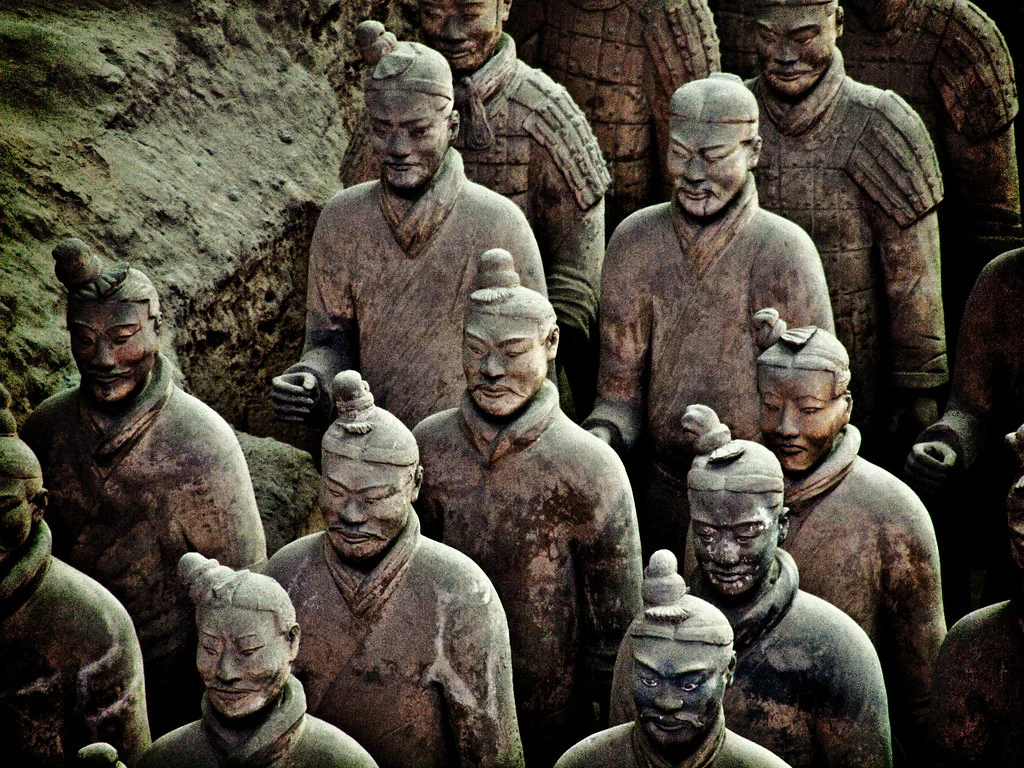
A repeated face that makes one figure feel both individual and part of an enormous system.
Summary
A repeated face that makes one figure feel both individual and part of an enormous system.
Reading status
A visual reading of a terracotta warrior example. It does not identify a specific excavated figure or prove age from a photo.
At a glance
A life-sized clay figure with a composed face, layered clothing, and traces of a larger formation around it.
- Subject
- Terracotta warrior
- Period
- Qin dynasty, 3rd century BCE
- Medium
- Painted terracotta
- Setting
- Mausoleum context, Xi'an
Visible evidence
Why it matters
A terracotta warrior is useful because the surface carries two scales at once: the small evidence of modelling and the vast idea of an army made from repeated bodies.
Visible evidence
Look closer
Three details to carry with you.
- 01
Look at the face, hair, and hands as separate decisions rather than one generic figure.
- 02
Notice how the folds of clothing create a vertical rhythm down the body.
- 03
Search the background for evidence that this figure belongs to a group, not an isolated portrait.
Documented context
How it was made
Terracotta clay · Modelled and assembled parts · Pigment traces
Documented context
Story and context
The figures were made for the mausoleum complex of Qin Shi Huang, with workshop production balancing repeated forms and individual variations.
Documented context
Culture and context
The warriors are often encountered as a spectacle of scale. Looking at one face slows the story down to the craft of making a person out of clay.
Documented context
Honest facts
Keeping certainty visible.
- A photograph cannot identify a particular excavated figure or its original pigment condition without a catalogue record.
- The page discusses a visual example, not excavation, ownership, conservation, or value.
Interpretation
Interpretation
One way to read it.
The figure feels individual because the face resists perfect repetition, even though the larger system depends on repeated bodies.
Another reading
The sameness may be stronger than the individuality. What looks like personality could be the result of careful variation inside a strict system.
This example follows the same order as an Art Says Hi result. Visible details come first, documented context comes next, and interpretation stays clearly marked.
Take another look
Does the face feel like a portrait or a role? Look for the details that make the figure singular, then the details that return it to the army.
Upload a photoSources
Follow the sources, then return to the image. Some links lead to a collection or publisher website.
Image credits
Terracotta Warrior Statues at Xian, China
kevinpoh (opens in a new tab)CC BY 2.0 (opens in a new tab)
Resized and converted to WebP for local delivery; composition otherwise unchanged.