
Art and sculpture · Discovery
Documented artworkLas Meninas
A painting that makes the viewer part of the room before explaining why.
Summary
A painting that makes the viewer part of the room before explaining why.
Reading status
A documented Prado painting. The spatial reading is open to interpretation even where the historical setting is known.
At a glance
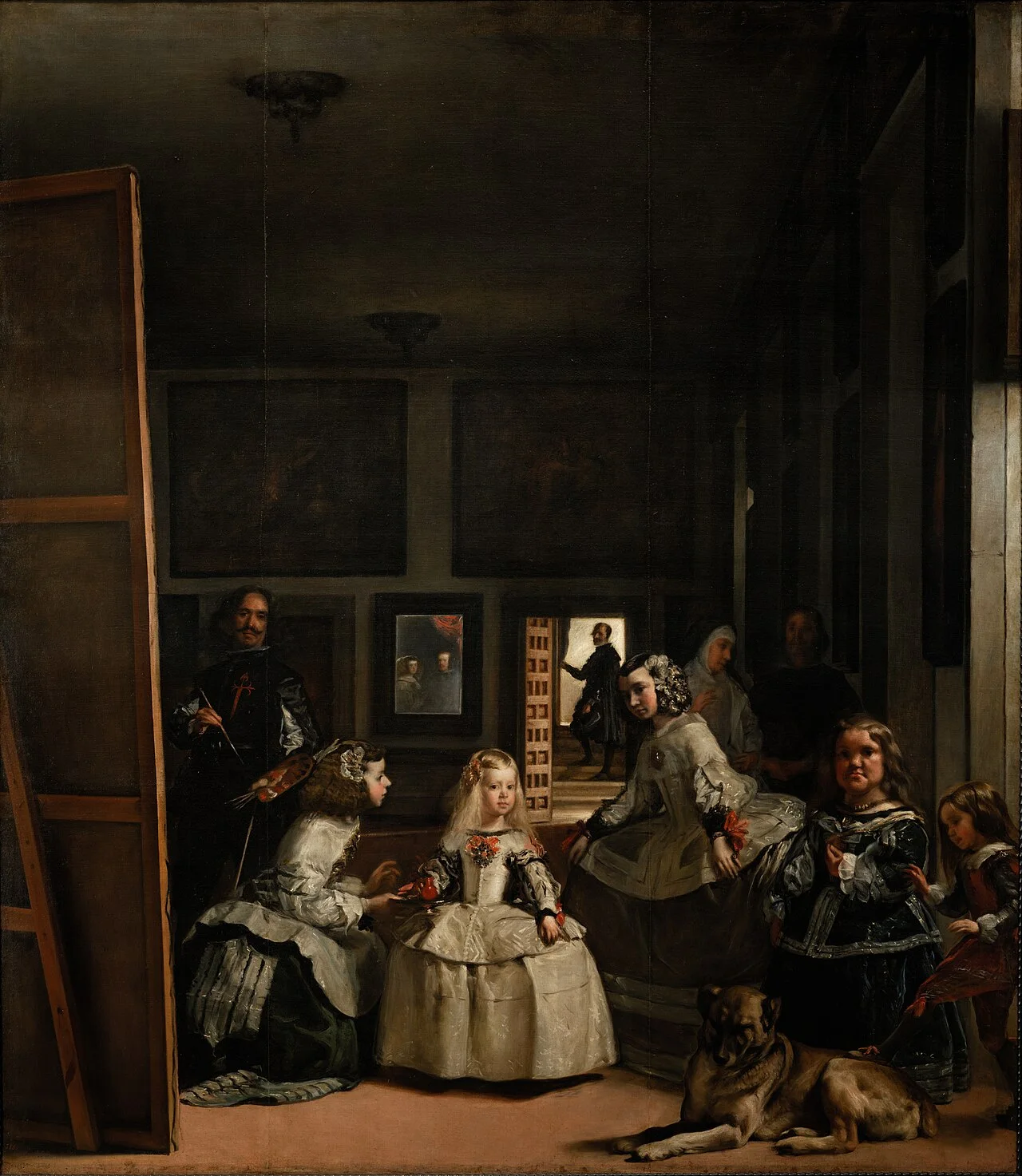
A court studio with figures, a painter, a mirror, and a doorway that opens the painted room toward unseen space.
- Made by
- Diego Velázquez
- Made
- 1656
- Medium
- Oil on canvas
- Collection
- Museo Nacional del Prado
Visible evidence
Why it matters
Velázquez builds a chain of looks across the studio. The work's puzzle is spatial, but its deeper pleasure is realizing that attention itself has become the subject.
Visible evidence
Look closer
Three details to carry with you.
- 01
Start with the figures who look outward, then find the mirror and the painter.
- 02
Notice how the large canvas at left hides as much as it reveals.
- 03
Follow the light from the foreground into the open doorway at the back.
Documented context
How it was made
Layered oil paint · Atmospheric perspective · Mirrored composition
Documented context
Story and context
Velázquez painted the work in the Spanish court, where the arrangement of the royal family, attendants, and painter carries social as well as spatial meaning.
Documented context
Culture and context
The painting keeps being discussed because it makes viewing part of its structure. It does not simply give you a scene; it gives you a position inside the scene.
Documented context
Honest facts
Keeping certainty visible.
- The identities and court context are documented through Prado scholarship, while the question of where the viewer stands is an interpretation.
- A cropped web image can hide the room's proportions and should not be treated as a full spatial record.
Interpretation
Interpretation
One way to read it.
The painting feels alive because it refuses a single stable viewpoint. The viewer is always slightly late to the explanation.
Another reading
The mirror may make the scene feel generous rather than puzzling: it returns the absent figures and lets the room acknowledge an outside world.
This example follows the same order as an Art Says Hi result. Visible details come first, documented context comes next, and interpretation stays clearly marked.
Take another look
Where do you think the room continues? Notice how the open doorway and unseen space in front of the canvas make the gallery feel larger.
Upload a photoSources
Follow the sources, then return to the image. Some links lead to a collection or publisher website.
Image credits
Las Meninas, by Diego Velázquez, from Prado in Google Earth.jpg
Diego Velázquez / Prado in Google Earth (opens in a new tab)Public domain (opens in a new tab)
Resized and converted to WebP for local delivery; composition otherwise unchanged.