
Guide · Symbols and iconography
Reading symbols in old paintings: a starter iconography
Skulls, snuffed candles, dogs and mirrors keep turning up in old paintings — and they usually mean something. Here is how to start decoding them without overclaiming.
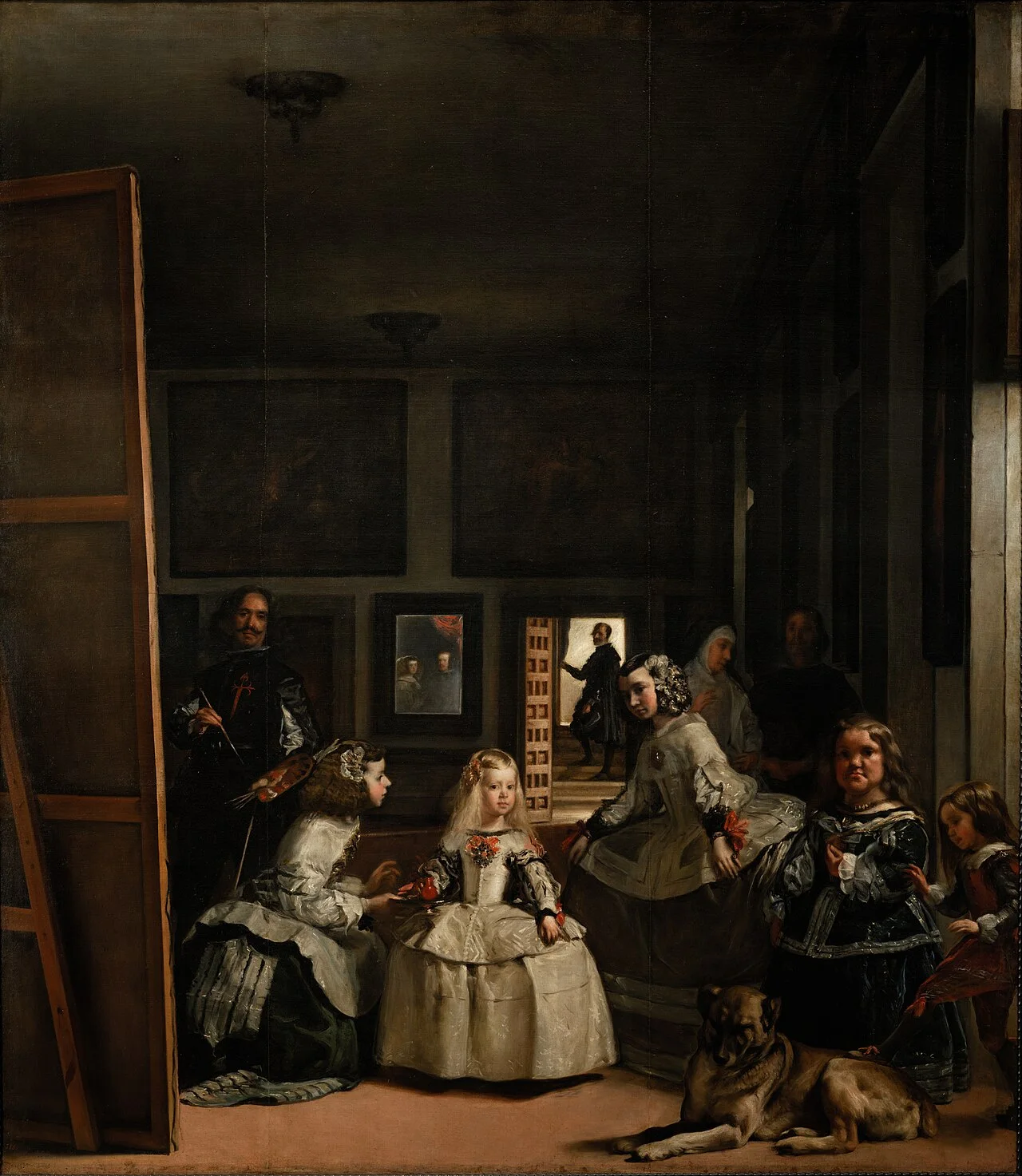
Old paintings are full of objects that were never just objects. The skull on the table, the dog at the couple's feet, the mirror on the back wall — for centuries, European painters used a shared vocabulary of things that viewers were expected to read. The National Gallery's glossary calls the study of that imagery iconography: what a picture shows, as distinct from how it was painted.
This guide is a starter set: the symbols that recur most often in old paintings, the way to read them in context, and the one rule that matters more than any list. A motif's documented association is not the same as this painting's meaning — the vocabulary comes first below, and that caution closes it.
Why old paintings carry codes
For centuries, much European painting served institutions that needed to be legible to viewers who could not read: churches, courts, civic patrons. The quickest way to say 'this is Saint Peter' was not a caption but a prop — so painters developed attributes, objects conventionally attached to a figure. The National Gallery's glossary defines an attribute as an object 'associated with — and seeming to identify — a particular figure': Saint Peter holds the keys of Heaven and Hell, Saint Catherine leans on the wheel of her attempted execution, Mary Magdalene carries the pot of ointment she used to anoint Christ's feet.
The device did not stay in altarpieces. As painting moved into domestic interiors and still life, objects kept doing double duty — a pewter jug is a jug, and it may also be a comment on the household, the market, or mortality. Museums still teach this decoding as a core skill: the Getty's education programme, for instance, publishes classroom resources built around close reading of individual works.
Two cautions before the list. First, symbols are habits, not laws: they are strongest inside the periods and places that used them — broadly, European painting from the medieval period through the seventeenth century. Second, an attribute identifies a figure; it does not certify what the painting means. That distinction returns at the end.
Faith and warning: skulls, candles, extinguished flames
The skull is the loudest symbol in the collection and the easiest to start with. Memento mori — Latin for 'reminder of death' — is the tradition the National Gallery describes: skulls appear in Northern European portraits and still lifes, and in South European depictions of saints, mostly in the sixteenth and seventeenth centuries, as a reminder that 'death is the great leveller'. Holbein's Ambassadors hides its skull in plain sight: an anamorphic smear across the front of the picture that resolves into a skull only from a sharp angle.
A skull with company usually signals vanitas, the still-life type the gallery glosses through Ecclesiastes — 'all is vanity'. In Harmen Steenwyck's An Allegory of the Vanities of Human Life, objects standing for human achievement — a book, instruments — are set beside a snuffed lamp and a skull: the works of a life, beside the thing that ends it. The extinguished candle or lamp is the quieter version of the same idea — a light gone out, a life ended or ending.
Read them in order: first the objects themselves (visible evidence), then the documented association (memento mori, vanitas), and only then what they might say about this picture. That layering is how the site's own readings are structured — the methodology page uses the same separation.
Loyalty and love: dogs, mirrors, fruit
The dog is the famous case. In van Eyck's Arnolfini Portrait, the small dog in the foreground 'may be intended to symbolise the fidelity of the couple' — and notice the National Gallery's own hedge, may be intended, which the next section returns to. Dogs do not carry a single meaning: Hogarth drops a scrawny mongrel into a collapsing marriage in Marriage A-la-Mode, Saint Eustace stands ringed by hounds at his conversion, and the hunter goddess Diana's attribute is a dog.
Mirrors do quieter work. The convex mirror in the Arnolfini Portrait shows the whole room from behind the painter's position — witnesses included. In Las Meninas, the mirror on the back wall holds the king and queen, which makes the royal presence part of a painting they are not visibly standing in. A mirror's symbolic freight varies by picture; what it shows is checkable first.
Fruit and flowers follow the still-life rule: the National Gallery notes that seventeenth-century Dutch still life was 'often associated with material decay and the futility of worldly life' — the tradition the vanitas and memento mori entries develop. A perfect pear is abundance; a pear going over, or petals already falling, leans toward time and loss. Ripeness is the detail to check.
Reading the room: gesture and gaze as grammar
Not every symbol is an object. Gesture and looking do similar work: who meets whose eye, who is turned away, whose hands point where. Las Meninas runs on exactly this grammar — a chain of gazes that keeps reassigning you a role in the room — and the site's example reading follows the chain rather than decoding it into messages.
Ornament can signal too. Klimt's The Kiss covers its lovers in pattern until the pattern itself becomes the subject — two figures wrapped in different decorative fields meeting at one edge. The Belvedere's collection record is the place to check what is documented — title, date, holding — before treating any motif as a message.
The rule of thumb: read relationships before symbolism. Whose gaze organises the scene, who is ignored, what the hands are doing — these are visible facts that survive even when the iconographic reading stays open.
When a symbol is a maybe, not a fact
The National Gallery's 'may be intended' is doing precise work. A motif can have a documented association — dogs and fidelity — while a particular painting only suggests it. Meaning depends on period, region, patron, and the objects the motif shares the picture with; the same species is fidelity in one portrait and a hunter's attribute in another.
So hold symbol claims the way museums hold attributions: as statements with a confidence level. The attribution-terms guide shows how museums hedge authorship in public; iconographic readings deserve the same hedging — 'often associated with', 'in this period', 'may carry'. If a book or label gives a symbol a definite meaning without evidence, the certainty is the suspect part.
A useful test: does anything else in the picture support the symbolic reading? A skull beside extinguished light and wilting flowers strengthens a vanitas reading; the same skull in a scholar's portrait may be a memento mori habit rather than a message about this sitter. Context is not decoration around the symbol — it is the evidence.
Try it on a documented painting
Take a symbol-heavy work — the site's Las Meninas or The Kiss examples both work — and list every object that might be doing double duty. Then check each candidate against the museum's own record or glossary entry: documented association first, meaning second.
Finally, scan a symbol-heavy work — yours, or one you photograph where photography is allowed — and see whether the reading names the same details you flagged. What comes back is AI-generated and provisional: it will describe what is visibly there and mark uncertain claims as uncertain; the iconographic call stays yours.
Take another look
The next time a painting puts an odd object in your way — a skull, a snuffed candle, a watching dog — ask what job it is doing before asking what it means. If you have the picture, the scanner will tell you what is visibly there — an AI-generated, provisional description; what it signifies is still your call.
Sources
- National Gallery, glossary: attribute (opens in a new tab)
- National Gallery, glossary: memento mori (opens in a new tab)
- National Gallery, glossary: vanitas (opens in a new tab)
- National Gallery, glossary: dogs (opens in a new tab)
- Getty, education resources (opens in a new tab)
- Belvedere, collection record: The Kiss (opens in a new tab)
Symbol glosses follow the National Gallery's glossary entries and the museums' own collection records; what a symbol means in a particular painting remains interpretation, not fact. Sources last checked 2026-10-01.
Read a photo of your ownYour photo is only sent when you choose Start reading.
Spotted an error? Tell us