
Guide · Attribution
"Attributed to", "circle of", "school of": the museum words for maybe
Museums write their confidence into the label. Once you can read the qualifiers, a wall of maybes becomes a map of the evidence.
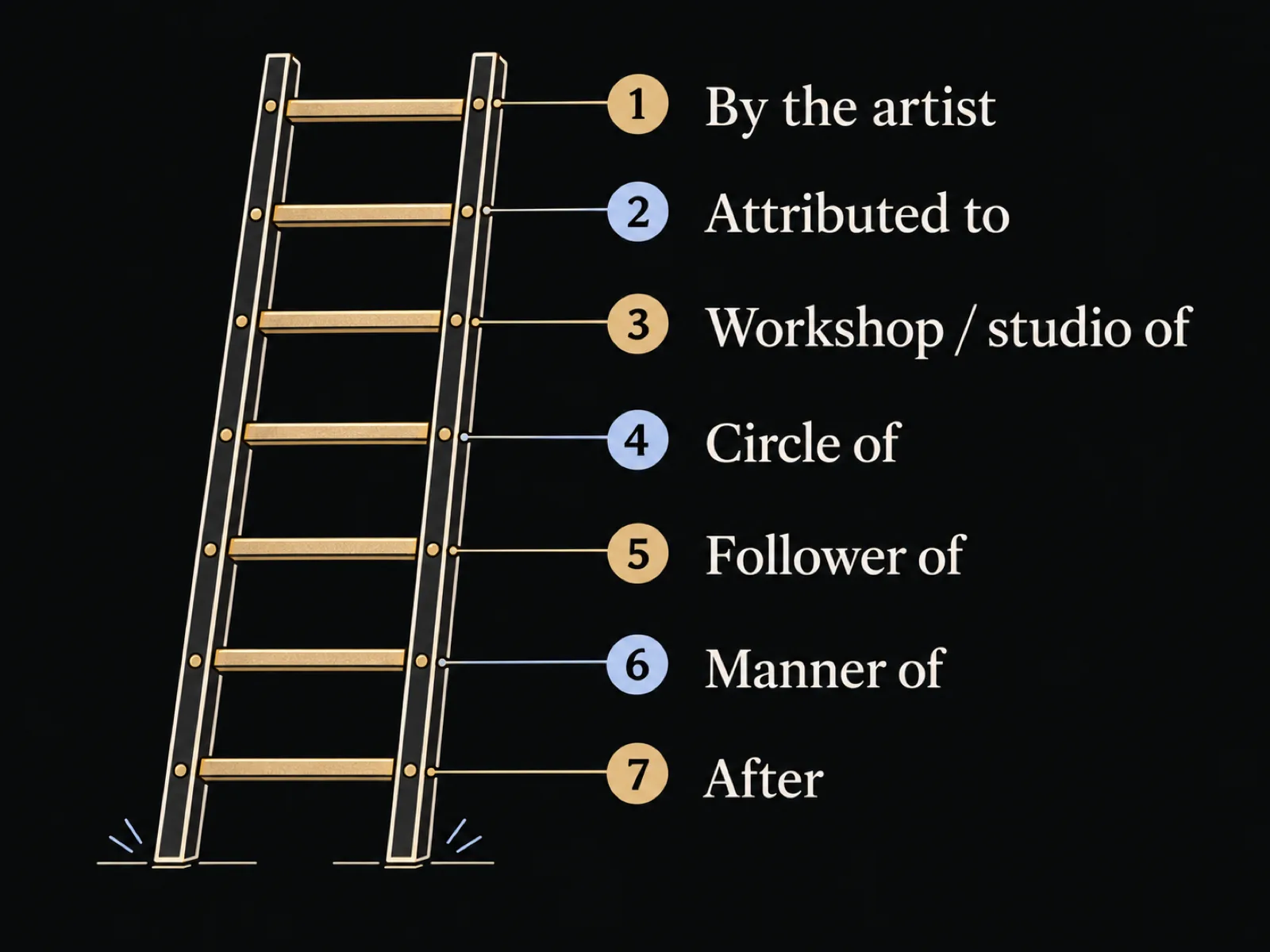
Next time a museum label hedges — 'attributed to', 'workshop of', 'circle of' — read it as a measurement, not a shrug. Each phrase records how confidently the institution connects the work to a named maker, and the differences between them are deliberate.
One warning first: the words are not standardised to the comma. Museums, catalogues, and auction houses each keep their own conventions, and the same phrase can weigh differently in different hands. The ladder below is the common shape, not a universal scale.
Why museums hedge in public
An attribution is a conclusion, not a caption fact. The scholar's question — whose hand held the brush — is answered from evidence that keeps arriving: technical imaging, conservation, newly found documents, comparisons with securely attributed work. A label that says 'attributed to' is an institution publishing its current confidence level, and that is more honest than certainty it cannot support.
It is also not a value judgement. A workshop piece can be superb and a securely attributed work minor; the qualifier measures evidence, not quality. Price is a separate conversation the market has anyway — the label is not whispering about it.
There is also a practical honesty to it: attributions are made by committees, catalogues, and decades of scholarship, so a label is the visible tip of a deliberated judgement. The hedge is not a lawyer's caution — it is the institution writing down exactly where the evidence currently lands.
The same instinct explains why museums keep qualifiers even for very famous works: the label records the state of the evidence, not the state of the marketing. A hedge today is a label that will still be honest after the next technical study.
The confidence ladder, from 'by' to 'after'
Ordered roughly from most to least confident, the common rungs are: by — the institution accepts the named artist as the maker; attributed to — probably by them, with some reservation; workshop of or studio of — produced in the artist's own operation, possibly with the master's hand in places; circle of — by someone working in the artist's orbit, time, or region; follower of — by an admirer who took up the artist's style, in the artist's time or after; manner of — in the style of, possibly much later; after — a copy of a known composition by that artist.
The Getty's Art & Architecture Thesaurus maintains a formal hierarchy of these qualifiers — proof that 'the museum words for maybe' are a considered vocabulary, not vagueness. Both the National Gallery's glossary and Tate's art terms define the same family with slight variations, which is exactly the point: institutions tune the ladder to their collections.
You will also meet modifiers and rarer rungs — 'probably', 'possibly', 'formerly attributed to', 'school of' for a regional tradition or a named master's orbit — and the order between them is genuinely debated between institutions. What stays fixed is the direction of travel: each qualifier moves the maker a step further from the named hand.
Notice that none of these words accuse. 'After Michelangelo' is not an allegation of fakery — it is a record of copying, which for centuries was how compositions travelled.
You can hold one useful anchor while reading: 'by' is a claim about a hand, 'after' is a claim about a composition, and everything between them is a claim about proximity — in time, place, or working relationship.
Workshop, studio, circle, follower
The middle rungs cause the most confusion because they describe different relationships, not just different doubts. A workshop or studio piece came out of the artist's own production line — assistants preparing panels, painting drapery, sometimes finishing whole works to the master's design. A circle is looser: contemporaries in the same city, court, or network, influenced rather than employed. A follower is someone who admired and adopted the style without a documented tie to the studio — the National Gallery's glossary defines one as 'someone who admired the artist's style, but was not necessarily a pupil of his', and the word leaves the follower's century open.
So 'circle of Rembrandt' and 'follower of Rembrandt' say genuinely different things: one places the maker beside the man in time and milieu; the other claims only stylistic kinship — an admirer, contemporary or later, not a studio link or a date. Reading the difference tells you what kind of uncertainty the museum is carrying.
Large workshops were the rule rather than the exception in periods that produced the most-attributed names — Renaissance studios, Dutch seventeenth-century practices, Rembrandt's own operation. An artist running a successful studio was doing something closer to directing a small company than painting alone, and the qualifiers preserve that fact instead of tidying it away.
A few more rungs appear in larger catalogues: 'pupil of' names a documented student of the master, and 'assistant of' a recorded studio hand — both sit closer than 'circle', and both still stand several steps away from 'by'.
When qualifiers change (and why that's healthy)
Attributions move. Cleaning reveals a different hand under old varnish; a document surfaces; technical examination reassigns a work — famously, the Rembrandt Research Project spent decades moving paintings between 'by' and 'workshop of' and back again. A label that changed is not a museum being wrong; it is the evidence doing its job in public.
That willingness to revise is the same posture the methodology describes for image readings, and the essay on why uncertainty deserves its own vocabulary argues it is a feature, not an apology.
De-attribution even makes headlines — a famous name quietly becomes 'workshop of' and the newspapers call it a downgrade. Scholars call it progress: the catalogue got more accurate, and the object lost nothing it ever actually had. The price may care; the evidence doesn't.
Reading a qualifier in a catalogue entry
In a museum catalogue the qualifier sits inside a scholarly apparatus — provenance, technical notes, literature. In an auction catalogue the same words often carry contractual weight: auction houses publish their own definitions of what 'attributed to' means for that sale, and those definitions can differ from museum usage. If money is involved, read the sale's own terms first.
Practice on two familiar works. The Mona Lisa reading rests on one of the most secure attributions in art — yet its records still carry qualifications about date and history. American Gothic is unambiguous 'by Grant Wood' — a clean top rung to measure the hedged labels against.
Catalogue shorthand compresses two different things. 'Attrib.' shortens an authorship qualifier — part of the confidence vocabulary above. 'Fl.' (floruit) and 'c.' (circa) are date shorthand, not qualifiers: 'fl.' marks the period a person was active when exact life dates are not known, and 'c.' marks an approximate date. Neither makes the maker anonymous or the authorship doubtful — a securely identified artist can still be 'fl. 1480–1520' simply because those are the dates that survive.
A last distinction to carry into catalogues: 'school of' wears two meanings. 'School of Fontainebleau' names a regional tradition — geography and training rather than a personal link. 'School of Rembrandt' names the master's own orbit — painters working in his style or trained in his milieu without a documented pupil tie, the usage the Getty's cataloguing guidance defines. Read the qualifier against what follows it: a place points to a tradition, a name points to an artist's pull.
How Art Says Hi labels its own uncertainty
The scanner uses the same philosophy at smaller scale. When a reading says a work is 'possibly' a style or 'likely' a period, it is publishing a confidence level with its evidence visible — the museum-label move translated for a photograph. You can try it on a photo and watch where the hedges land.
Museums hedge because they are accountable to scholarship; a reading hedges because it is accountable to your eyes. Both are asking to be checked, not believed.
That is also why the reading pages show their work: the hedges sit next to the features they rest on, so 'possibly' can be checked rather than merely believed — the same courtesy a label extends when it writes 'attributed to' instead of 'by'.
Take another look
Next label you meet, find the qualifier before the name — then check the museum's own conventions if the word matters. Try a photo in the scanner and notice where it uses the same honesty.
Sources
- Getty Art & Architecture Thesaurus, attribution qualifiers hierarchy (opens in a new tab)
- Getty CDWA, Creator Qualifier guidance (opens in a new tab)
- National Gallery, Attribution glossary (opens in a new tab)
- Tate, Art terms (opens in a new tab)
The ladder summarises common museum usage; conventions vary between institutions, catalogues, and auction houses. Sources last checked 2026-10-01.
Read a photo of your ownYour photo is only sent when you choose Start reading.
Spotted an error? Tell us