
Guide · Vocabulary
A working vocabulary for looking at images
Composition, tone, silhouette, patina, negative space — the small set of words that turn a private look into a shareable one. Each with a definition and a page where you can watch it work.
Looking at an image and having nothing to say usually means missing words, not missing eyes. This is a working glossary — seventeen terms that do the most lifting in visual description — written in this site's voice, each with a check and a ‘seen in’ link to a page where the word earns its keep.
Museums keep their own, fuller versions: Tate's art terms, the National Gallery's painting glossary, and the Getty's Art & Architecture Thesaurus — the structured vocabulary behind many museum records. This list is deliberately smaller: the words you will actually reach for when describing what a picture is doing.
How to use this glossary
Not a test — a toolkit. Each entry gives a one-line definition, a way to check the term against a picture, and a pointer to an example page where it does real work. The test of knowing a word is whether you can point at what it names.
A word is a pointing device, not a verdict. ‘High-key’ does not say whether a picture is good; it says where its tones sit, so two people can talk about the same thing. That is the entire point of the vocabulary.
Where a fuller institutional definition exists, the sources at the foot of the page are the deeper reference — and for the separate vocabulary of who made it, the attribution terms guide decodes ‘attributed to’, ‘circle of’ and the rest. And because every term here ends in a check, you can test any of them against the next thing you photograph — including anything you send to the scanner, whose readings are AI-generated and provisional: drafts to argue with, not verdicts.
Words for arrangement: composition, balance, rhythm, negative space
Four words for how the parts of a picture are organised.
Composition — the arrangement of the elements within a work: where things sit, how they relate, what leads where. Check: can you describe where the biggest shapes are without naming what they depict? Seen in The Great Wave, where the wave, the boats and a small distant Fuji are arranged so the emptiness matters as much as the crest.
Balance — how visual weight distributes across the picture. It does not require symmetry: a small dark mass can counterweigh a large pale field. Check: tip the picture mentally — would anything slide? Seen in Nighthawks, where a bright wedge of diner balances an empty street.
Rhythm — repetition that gives the eye a beat: the same mark, arch or fold returning at intervals. Check: find the element that repeats, then find where the pattern breaks — the break is usually deliberate. Seen in the clawed foam repeating across The Great Wave.
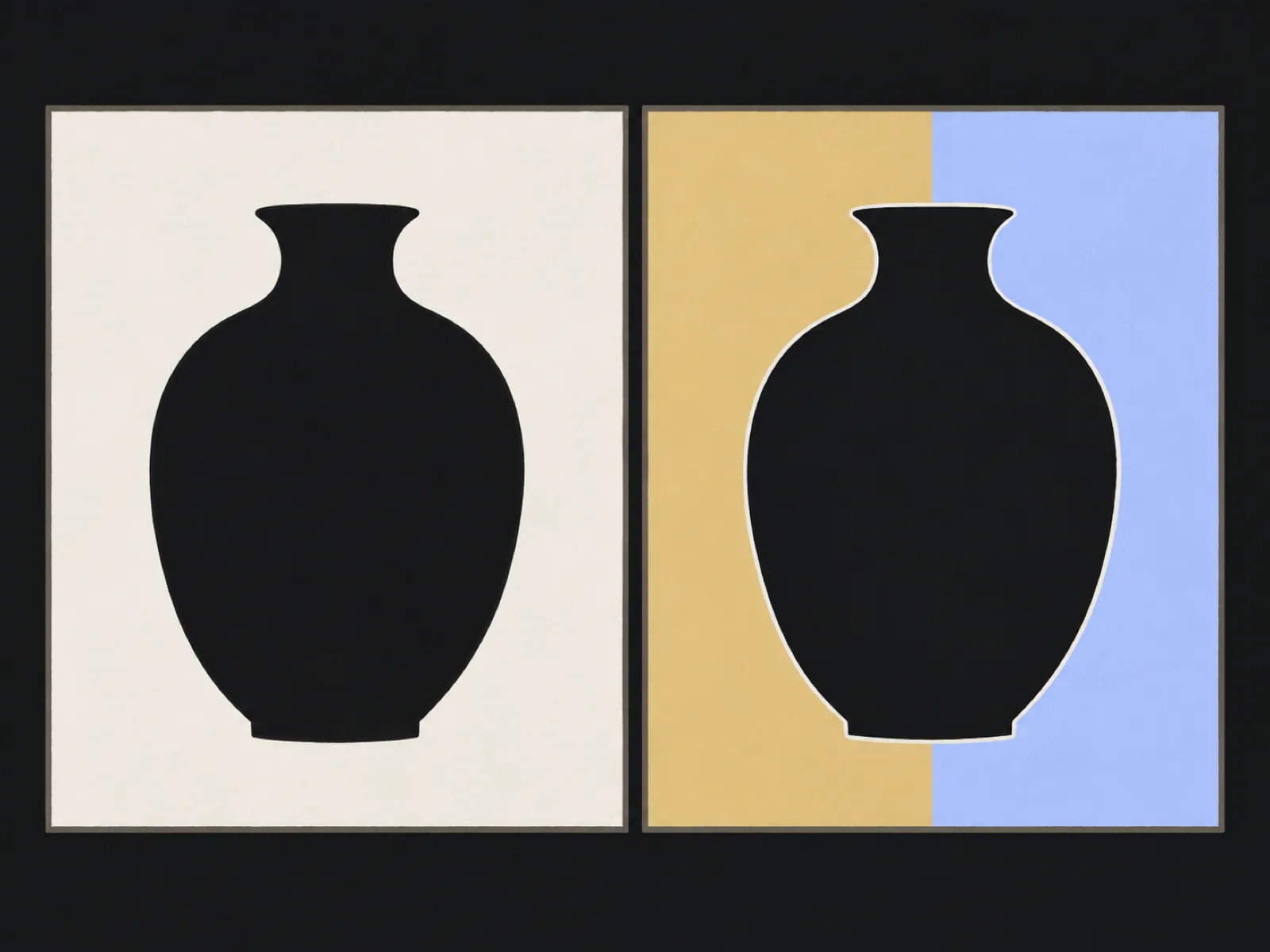
Negative space — the area around and between the forms: the shapes the subject does not fill. In strong pictures it is as organised as the subject itself. Check: describe the empty areas as if they were shapes. Seen in Nighthawks, where the dark street is the largest single shape in the picture.
Words for surface: texture, patina, craquelure, glaze
Four words for what the surface itself is doing.
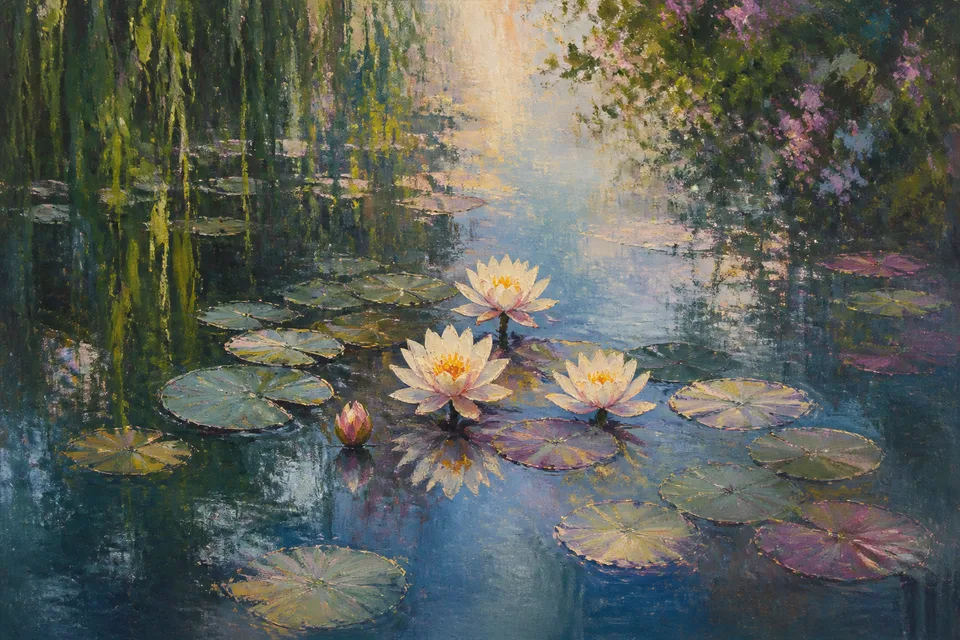
Texture — what the surface is or appears to be: rough, smooth, woven, stippled; in a painting, the paint's own body counts as surface. Check: does it look like skin, glass or cloth? Seen in Water Lilies, where the broken, visible brushwork is the subject as much as the pond.
Patina — the change a surface collects through age and handling: darkened varnish, a sheen worn into metal, stone softened by weather. The word describes how a surface looks, not how it will behave — some patinas are stable while others are part of continuing deterioration, and telling them apart is a condition question rather than a vocabulary one. Seen in the vintage biscuit tin, whose scuffs record decades of handling.
Craquelure — the network of fine cracks that forms in aged paint or varnish as the layers move over time; its spacing and pattern carry information about materials and history, and the repair and wear guide shows what crack networks can reveal about later work. Seen in the Mona Lisa, whose aged paint film on a poplar panel is the kind of surface the word describes.
Glaze — a thin, transparent layer of paint laid over dried paint, deepening colour and changing how light sits in the surface. Seen in the Mona Lisa, where the famously gradual transitions around the face were built from thin, layered applications of paint.
Words for light and colour: tone, temperature, key
Three words for how light and colour carry the picture.
Tone — the relative lightness or darkness of an area, independent of its colour. Check: squint until the colours blur — what remains is the tone structure. Seen in Guernica, where the palette is squeezed to near-monochrome and tone does almost all the work.
Temperature — the warm-or-cool bias of a colour, or of a whole picture. Check: name the warmest and coolest passages and ask what each is doing. Seen in Nighthawks, where the warm diner light sits inside a cool, dark city.
Key — a picture's overall tonal register: high-key pictures live towards the light end, low-key towards the dark. Check: is most of the surface nearer white or nearer black? Seen in The Starry Night, a low-key field punctured by high-key moons and stars.
Words for structure: silhouette, proportion, axis
Three words for the picture's armature — the scaffold the details hang from.
Silhouette — the outer contour of a form: the shape you could cut out with scissors. Check: trace the outline in the air — is it compact, spiky, continuous? Seen in The Thinker, whose hunched silhouette carries the pose before any detail does.
Proportion — the size relationship between the parts, and between each part and the whole. Check: which part is larger or smaller than you expected? Seen in the Anglepoise lamp, where the reach of the arm against the size of the head is the design.
Axis — the implied line a composition organises itself around: vertical, horizontal or diagonal. Check: is there a spine the elements hang from? Seen in Guernica, where a wide horizontal field resolves around a dense central cluster.
Words for wear: foxing, bloom, restoration
Three words for what time and later hands do to an object — the vocabulary of age.
Foxing — small brownish spots and staining that appear on old paper, common on prints, drawings and book pages; associated with damp storage and reactions within the paper. The word names the marks, not their behaviour — the Canadian Conservation Institute notes foxing can become more pronounced under sustained high humidity, so whether the change is finished is a condition question for a paper conservator. Seen in the vintage railway ticket, where reading old card means deciding which marks were printed and which arrived later.
Bloom — a hazy or cloudy film that can appear on a varnished or polished surface; it sits on the surface layer and is not necessarily damage to the paint beneath it. As with patina, the word names an appearance rather than a cause — what produced the haze, and whether it is stable, is an examination question. Seen in the Vespa's painted shell, a polished surface where a film of haze would sit above the colour.
Restoration — later work done to an object: retouching lost paint, repairing breaks, replacing parts. It is an intervention rather than an accumulation — the distinction the repair guide is built on. Seen in the Victorian London terrace, whose material notes list later repairs among the surface materials.
Seventeen words will not make you a specialist — that was never the offer. They let you say what you see precisely enough to be disagreed with, which is the point. An AI-generated reading uses the same vocabulary in its visible-evidence layer, so the words you practise here are the words a provisional result speaks in.
Take another look
Pick one word and carry it into the next museum or the next photograph: watch what it lets you notice that you skipped before. Then bring a picture to the scanner and find your word in the evidence layer of the provisional draft it returns.
Sources
- Art terms (Tate) (opens in a new tab)
- Art glossary (National Gallery, London) (opens in a new tab)
- Art & Architecture Thesaurus (Getty Research Institute) (opens in a new tab)
- Basic care — works of art on paper (Canadian Conservation Institute) (opens in a new tab)
Definitions are stated in this site's voice and checked against the institutional glossaries below. Sources last checked 2026-10-01.
Read a photo of your ownYour photo is only sent when you choose Start reading.
Spotted an error? Tell us