Art and sculpture · Flagship
Documented artworkThe Starry Night
A night sky that refuses to stay still, held above a quiet village by a dark cypress flame.
Summary
A night sky that refuses to stay still, held above a quiet village by a dark cypress flame.
Reading status
A documented museum-held artwork. The visual reading is interpretive, while the collection and date are source-led facts.
At a glance
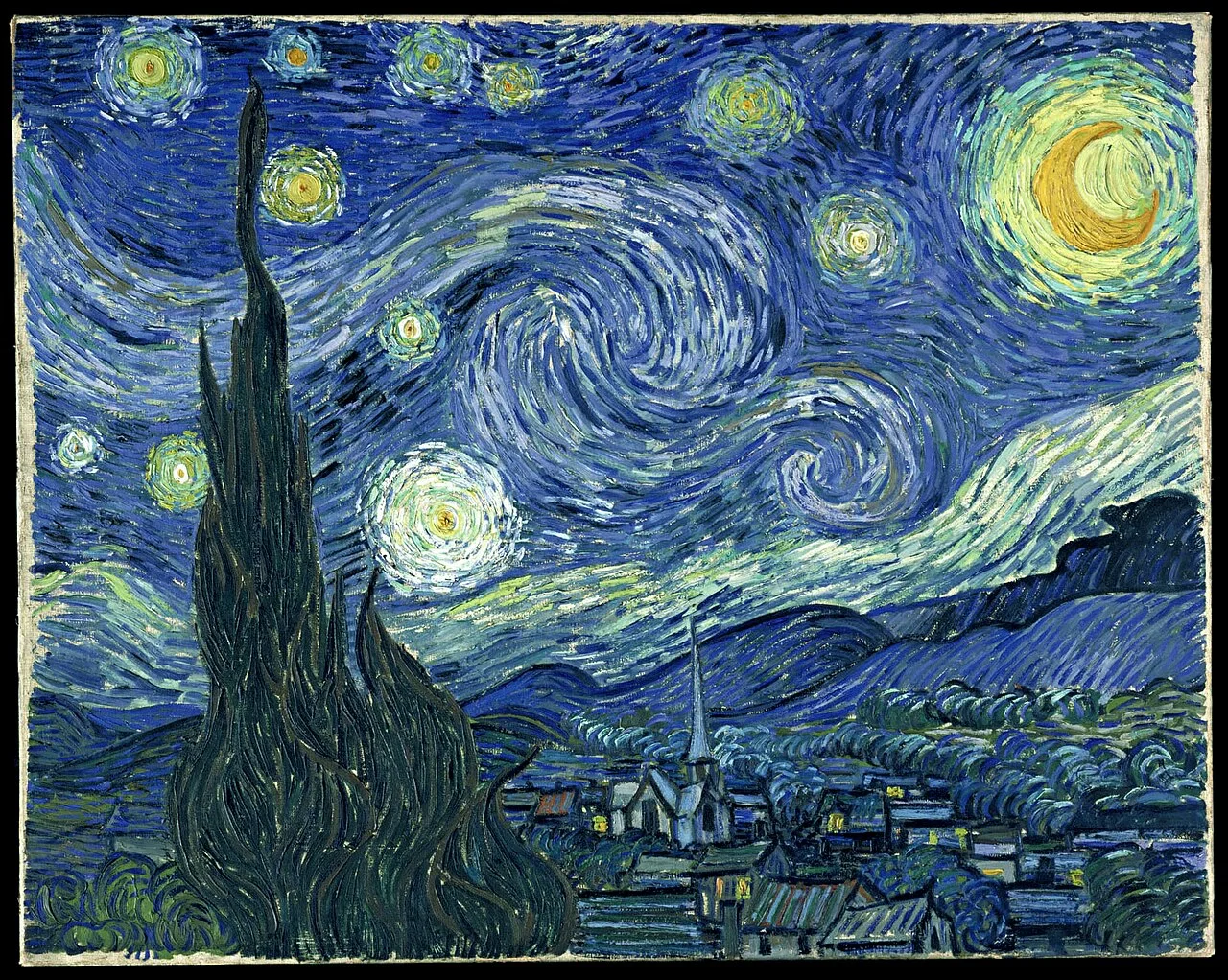
A village beneath a restless sky, with a cypress rising as a dark vertical between earth and atmosphere.
- Made by
- Vincent van Gogh
- Made
- 1889
- Medium
- Oil on canvas
- Collection
- The Museum of Modern Art, New York
Visible evidence
Why it matters
Van Gogh turns the sky into the most active thing in the scene. The village is calm, but the paint keeps moving, as if the night has its own weather.
Visible evidence
Look closer
Three details to carry with you.
- 01
Follow the repeated curls in the sky before naming the stars. The brushwork makes atmosphere feel almost physical.
- 02
Compare the tall cypress with the small church tower. Both reach upward, but they carry different kinds of weight.
- 03
Notice the quiet windows below the energetic sky. The contrast gives the scene its emotional pressure.
Documented context
How it was made
Directional brushwork · Expressive colour · Compressed perspective
Documented context
Story and context
Van Gogh painted the work in 1889 while staying at Saint-Paul-de-Mausole in Saint-Rémy, combining remembered forms with the view from his room.
Documented context
Culture and context
The work is often discussed as a turning point where landscape becomes a carrier of emotion rather than a straightforward record of place.
Documented context
Honest facts
Keeping certainty visible.
- The painting is in the collection of The Museum of Modern Art, but this page is a looking guide rather than a conservation report.
- The emotional language is interpretation, not a statement of Van Gogh's private mental state.
Interpretation
Interpretation
One way to read it.
The sky feels alive because the marks refuse to describe it from a distance. They make looking feel like entering a current.
Another reading
Another reading is that the village offers calm precisely because the sky refuses to settle.
This example follows the same order as an Art Says Hi result. Visible details come first, documented context comes next, and interpretation stays clearly marked.
Take another look
Does the cypress connect the ground to the sky, or does it interrupt the view? Notice how your answer changes the emotional temperature.
Upload a photoSources
Follow the sources, then return to the image. Some links lead to a collection or publisher website.
Image credits
VanGogh-starry night ballance1.jpg
Vincent van Gogh (opens in a new tab)Public domain (opens in a new tab)
Resized and converted to WebP for local delivery; composition otherwise unchanged.