
Art and sculpture · Discovery
Documented artworkGuernica
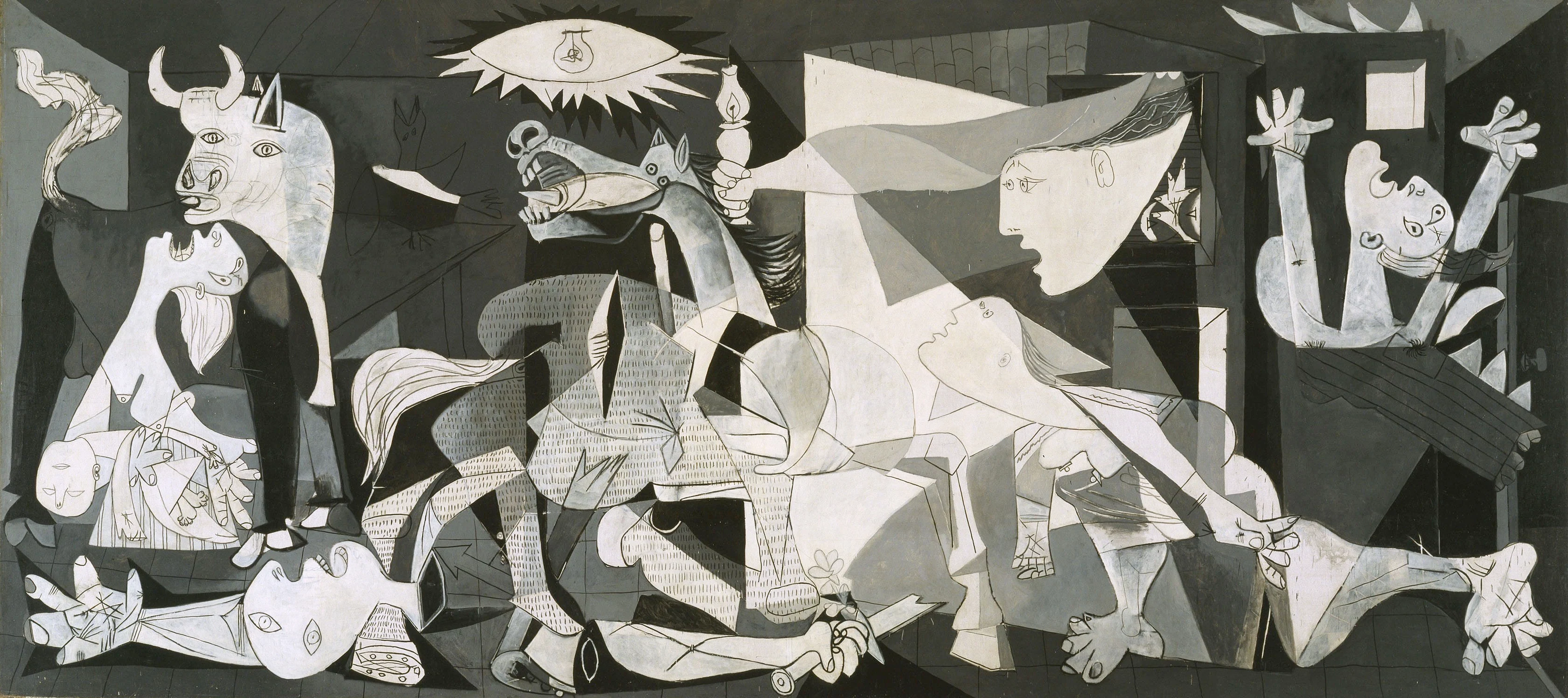
A fractured room where grief refuses to become a single image.
Summary
A fractured room where grief refuses to become a single image.
Reading status
A historically documented artwork. The image credit describes a reproduction, and the page does not imply access to the original canvas.
At a glance
A wide, monochrome field of broken bodies, repeated eyes, sharp light, and compressed space.
- Made by
- Pablo Picasso
- Made
- 1937
- Medium
- Oil on canvas
- Collection
- Museo Reina Sofía
Visible evidence
Why it matters
Picasso's compressed space and broken forms do not offer a neat narrative. They make the viewer move between bodies, symbols, and the violence of looking.
Visible evidence
Look closer
Three details to carry with you.
- 01
The sharp contrasts make the scene feel lit by an unstable flash.
- 02
Follow the repeated eyes and mouths to see how suffering is distributed across the whole room.
- 03
Notice how the horizontal scale makes individual figures feel caught in a larger structure.
Documented context
How it was made
Monochrome palette · Cubist fragmentation · Large horizontal composition
Documented context
Story and context
Picasso painted the work in response to the bombing of Guernica during the Spanish Civil War for the 1937 Paris International Exposition.
Documented context
Culture and context
The painting is often read through its historical subject, but its lack of a single story is part of how it communicates collective violence.
Documented context
Honest facts
Keeping certainty visible.
- The image used here is a licensed reproduction on a tiled wall, not the original canvas or museum installation.
- Symbolic readings should be stated as interpretations rather than as a single official key to every figure.
Interpretation
Interpretation
One way to read it.
The picture refuses to let grief settle into one emblem. Pain is distributed across the whole visual field.
Another reading
The grayscale can make the scene feel documentary, but it can also make it feel like a memory stripped of ordinary time.
This example follows the same order as an Art Says Hi result. Visible details come first, documented context comes next, and interpretation stays clearly marked.
Take another look
What does the lack of colour change? Follow one shape at a time before deciding whether the scene feels documentary, symbolic, or both.
Upload a photoSources
Follow the sources, then return to the image. Some links lead to a collection or publisher website.
Image credits
Guernica - Pablo Picasso - 1937 - Museo Nacional Centro de Arte Reina Sofía a Madrid, 2024.jpg
Pizieno (opens in a new tab)CC0 1.0 (opens in a new tab)
Resized and converted to WebP for local delivery; composition otherwise unchanged.