
Art and sculpture · Discovery
Documented artwork familyWater Lilies
A surface where reflection, water, and paint keep trading places.
Summary
A surface where reflection, water, and paint keep trading places.
Reading status
A documented series rather than one single work. The exact painting and installation need a museum record.
At a glance
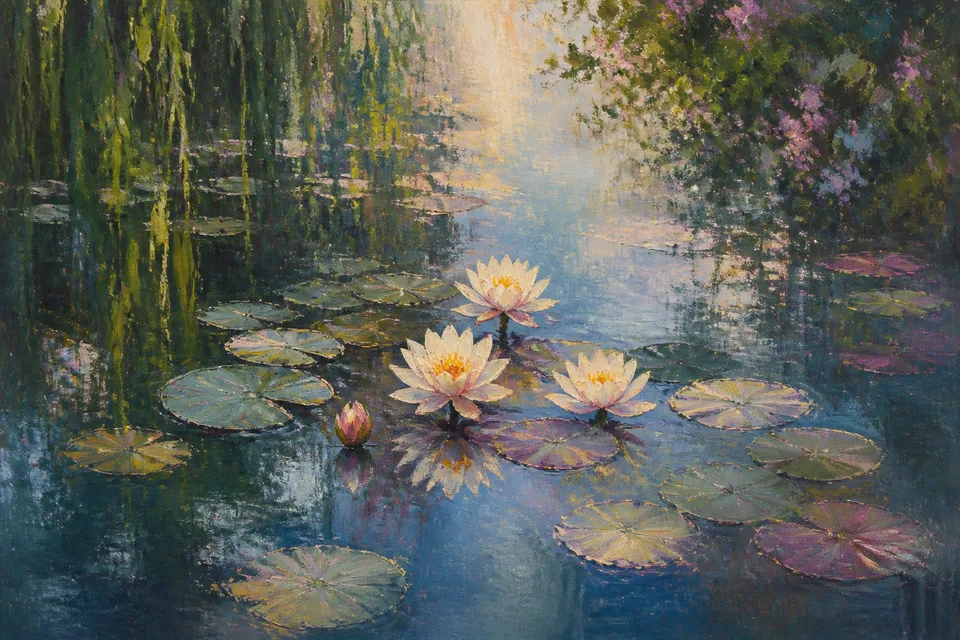
Floating flowers, reflected colour, and broken marks fill the picture without a firm horizon.
- Made by
- Claude Monet
- Made
- 1890s–1920s
- Medium
- Oil on canvas
- Setting
- Musée de l'Orangerie, Paris
Visible evidence
Why it matters
Monet's water-lily paintings reward a slow eye. The subject is familiar, but the picture keeps asking whether you are looking at flowers, water, light, or the act of seeing.
Visible evidence
Look closer
Three details to carry with you.
- 01
Let your eye move between the floating forms and the marks around them.
- 02
Search for places where a reflection becomes more solid than the flower beside it.
- 03
Notice how the lack of a hard horizon changes the scale of the surface.
Documented context
How it was made
Broken brushwork · Layered colour · Reflections without a fixed horizon
Documented context
Story and context
Monet returned to the pond at Giverny over many years, making the changing surface a sustained subject rather than a single view.
Documented context
Culture and context
The series is a useful reminder that recognition and observation are different. Knowing the title does not remove the work's uncertainty about what exactly we are seeing.
Documented context
Honest facts
Keeping certainty visible.
- The Openverse image used here is a licensed detail photograph, not a claim to show one canonical museum installation.
- The web image can suggest surface and colour, but not the physical scale of a particular canvas.
Interpretation
Interpretation
One way to read it.
The paintings feel intimate and expansive at once because the surface gives you no stable edge to stand outside.
Another reading
The lack of a horizon can feel peaceful, but it can also make the viewer gently lost inside the reflection.
This example follows the same order as an Art Says Hi result. Visible details come first, documented context comes next, and interpretation stays clearly marked.
Take another look
What changes when you stop searching for a horizon? Let the surface be intimate, expansive, or gently disorienting before deciding.
Upload a photoSources
Follow the sources, then return to the image. Some links lead to a collection or publisher website.
Image credits
Detail of "The Water-Lily Pond" by Claude Monet 02.jpg
Kritzolina (opens in a new tab)Public domain (opens in a new tab)
Resized and converted to WebP for local delivery; composition otherwise unchanged.