
Food, print and everyday culture · Discovery
Visual readingVintage Biscuit Tin
A container that keeps its second life visible through colour, illustration, and the marks of use.
Summary
A container that keeps its second life visible through colour, illustration, and the marks of use.
Reading status
A visual reading of a vintage tin type, not a manufacturer, contents, safety, provenance, or value assessment.
At a glance
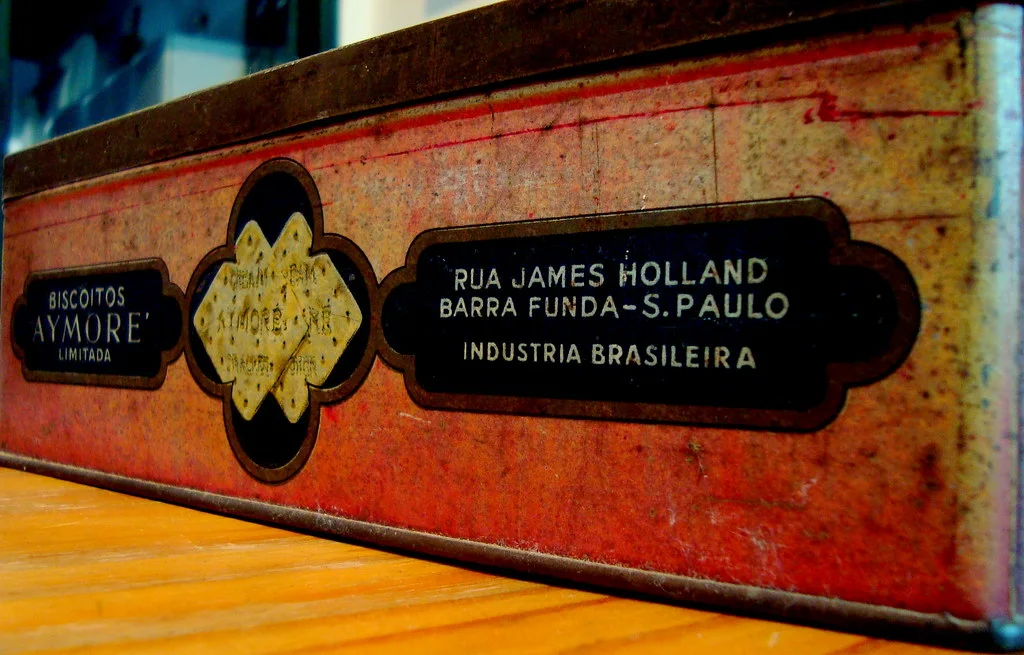
A decorated metal tin with a printed lid, repeated border, and a surface made to remain visible after the biscuits are gone.
- Subject
- Vintage biscuit tin
- Period
- 20th-century reference
- Materials
- Printed tinplate, ink
- Setting
- Domestic object reference
Visible evidence
Why it matters
The biscuit tin is a small archive of packaging and reuse. Its image is designed for the first purchase, then kept for a different household purpose.
Visible evidence
Look closer
Three details to carry with you.
- 01
Compare the lid's central image with its border and lettering.
- 02
Notice scratches, dents, and fading as evidence of a second life.
- 03
Look at the tin's corners and lid to see how decoration meets construction.
Documented context
How it was made
Tinplate · Printed ink · Hinged or friction-fit lid
Documented context
Story and context
Decorated tins became a durable part of food packaging and domestic storage, often outliving the product they first contained.
Documented context
Culture and context
The object moves from brand promise to family container. Its meaning is made by repetition in the home, not only by the image printed on it.
Documented context
Honest facts
Keeping certainty visible.
- A photo cannot prove manufacturer, date, contents, or food safety.
- This page is about packaging and reuse, not a claim about the tin's collectible value.
Interpretation
Interpretation
One way to read it.
The tin feels valuable because it is designed to stay. Its second life makes packaging look less disposable.
Another reading
The decorative surface may be less about memory than persuasion. The tin remains because the original design was good at asking to be kept.
This example follows the same order as an Art Says Hi result. Visible details come first, documented context comes next, and interpretation stays clearly marked.
Take another look
When does the tin stop being packaging and become part of the household?
Upload a photoSources
Follow the sources, then return to the image. Some links lead to a collection or publisher website.
Image credits
Box of Biscuits Aymoré Ltd - 50's [Caixa de Biscoitos da Aymoré dos Anos 50]
[JP] Corrêa Carvalho (opens in a new tab)CC BY 2.0 (opens in a new tab)
Resized and converted to WebP for local delivery; composition otherwise unchanged.