
Guide · Marks and inscriptions
Signatures, hallmarks, stamps and edition numbers: what marks can and can't tell you
Marks are evidence, not verdicts. A signature can be added later, a hallmark can be transposed, and an edition number describes a print run — not authenticity. How to read the four commonest kinds.
Somewhere on almost every old object there is writing: a signature in the corner, stamps on the back, a number like 14/50 in the margin, a row of tiny punched symbols on the metal. These marks feel like answers. They are better understood as evidence — each kind can tell you something real, and each has a well-practised way of lying.
This guide reads the four mark families you are most likely to meet — signatures, hallmarks, stamps and labels, and edition numbers — with the same discipline the rest of these guides use: a mark is a clue about origin, not a conclusion about it. For the collecting side of the job, the Clark Art Institute's research guide treats exactly these marks as the raw material of identification.
The family of marks: signature, stamp, hallmark, edition
Marks are physical, which makes them the friendliest kind of evidence — they can be photographed, compared, and checked against reference works. The Clark guide's list of what to hunt is a good inventory: signatures and monograms, hallmarks and stamps, foundry and maker's marks, edition numbers, and the paper trail of gallery, exhibition, and auction labels.
Each kind answers a different question. A signature claims authorship. A hallmark certifies metal and often place. A framer's or dealer's stamp supplies a shop and a city. An edition number describes a print run. A label ties the object to a room it once hung in. None of them, alone, answers 'is it real' — the question people actually want answered.
The working rule from the Clark guide: collect marks as evidence to check, not conclusions to announce. Photograph them before you interpret them — the photography guide has the technique — because a mark you cannot re-examine is a mark you cannot test.
Signatures
A signature is a claim that somebody with that name approved the object — no more, no less. As the Clark guide warns, signatures are forged, added to unsigned works later, transposed from lesser works, and honestly misread; a name on a painting settles the question 'what does this corner say', not 'who made this'.
On prints there is an extra trap, and it is about execution rather than location. A signature captured into the printing plate reproduces with every impression — it was part of the image, and it proves nothing about who touched the sheet. A hand signature can sit in the margin, but catalogues also describe impressions signed in graphite within the image itself, so where a signature sits settles neither the medium nor the authenticity. What separates the two is how the mark was made: printed ink sitting inside the same dot or grain pattern as the picture, versus a pencil or ink stroke resting on the surface.
Then there is the centuries-deep problem the Clark guide names directly: copying esteemed Old Masters has been common practice for centuries, and a faithful copyist may reproduce the original's signature as part of the image. A signed 'Rembrandt' is a statement about a corner of canvas; attribution is a separate, harder question.
Edition fractions and what 'A/P' means
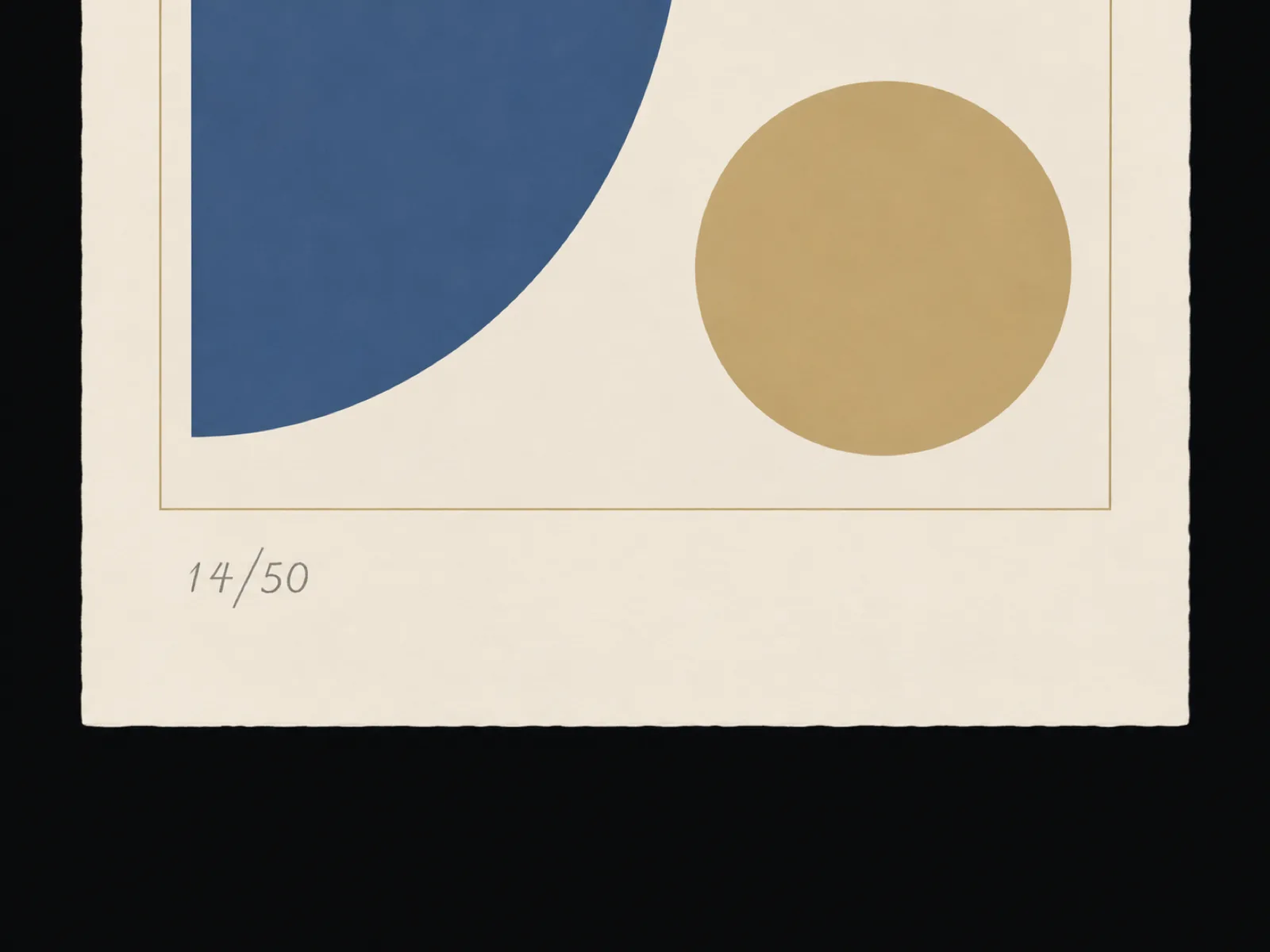
On prints, a pencilled fraction in the margin — 14/50 — is the edition number: this impression is number 14 of an edition of 50. The Clark guide uses exactly this example, 3/50. What it records is the declared size of the print run, which bears on scarcity; what it does not record is the order of printing, since impressions were not necessarily numbered in sequence.
Nearby markings read the same way. 'A/P' or 'E.A.' (épreuve d'artiste) marks an artist's proof — an impression outside the numbered edition. An edition size with no number, or a number with no edition, is still information: the practice itself is a convention, and conventions get loosely applied.
None of it proves the print is what it claims to be. Edition numbers get added to decorative reproductions too — a fake fraction costs one pencil stroke. The fraction tells you what the print claims; the plate mark, the paper, and the printing method — the painting-or-print guide has those checks — tell you whether the claim deserves belief.
Hallmarks: a language of small stamps
A hallmark is different in kind: it is a regulated mark struck after independent testing. In the UK system, a hallmark certifies that an article of gold, silver, platinum or palladium was assayed — tested — and meets a legal standard of fineness. The Goldsmiths' Company has run London's assay function for seven centuries.
A full traditional UK hallmark reads like a tiny sentence of five marks. The sponsor's mark — initials in a shield — identifies who submitted the piece for hallmarking; it establishes responsibility, not necessarily manufacture. The millesimal fineness mark gives the precious-metal content in parts per thousand, compulsory since 1999. The traditional fineness symbol names the metal. The assay-office mark says where it was tested — the leopard's head is London's town mark. And the date letter, when present, changes each year.
That makes hallmarks unusually honest marks — but not infallible ones. Marks can be transposed from a damaged piece onto another object, struck on imported metal of uncertain fineness, or simply faked. The Assay Office London itself runs an authentication committee for doubtful marks, which tells you the question is real.
When marks lie — reproductions and additions
Every mark family has its known deceits. Signatures get added to unsigned works and transposed onto copies. Hallmarks get cut out of damaged silver and soldered onto plate. Edition numbers get pencilled onto reproductions. And paper labels get moved between objects, aged artificially, or applied by owners who believed what they wrote.
The Clark guide's own caution is the honest summary: it has been common practice for centuries to copy esteemed Old Masters, and not every signed work — even an old one — was made by an established artist. Marks inherit all the uncertainty of the humans who struck, wrote or stuck them.
So treat every mark as a hypothesis with a suspect attached. Does the signature sit under the craquelure or over it? Do the hallmark's punches match a real assay office's registered marks? Does the edition number sit on a real print? The questions are checkable — that is what makes marks worth photographing in the first place.
Photographing marks so they can be read
Marks reward technique more than equipment. Get close — use the camera's closest reliable focus or a clip-on magnifier — keep the camera square to the surface for legible marks, and brace against something rather than trusting your hands.
Raking light is the trick that reveals what flat light hides: hold a lamp or phone torch low and to the side so incised stamps, plate marks and faint pencil throw shadows. Photograph every mark twice — once square-on to read it, once raking to prove it is really there — and keep the pair with a note of where on the object it sits.
The photography guide covers the whole discipline — even light, no glare, the back as well as the front — and the Clark guide's advice holds: transcribe what you can read while the object is in front of you, because a blurred photograph cannot be re-examined later.
Routes to a real identification
Hand it over when the marks would change a decision: buying, selling, insuring, publishing an attribution, or a suspected forgery. The routes match the mark — an assay office can help read doubtful hallmarks, print specialists read editions and states, and conservators can examine whether a signature shares the object's age.
Specialist reference works are the other half of the answer: the Clark guide points readers to the standard catalogues of marks, and auction-house specialists will often say what they can from good photographs — the same file the found-painting guide has you build.
And a scan helps at the start, not the end: an AI-generated reading can transcribe and describe a mark you are squinting at, flag what family it belongs to, and give you the vocabulary for the next search — a provisional draft to check. It cannot authenticate — nothing that works from a photograph can.
Take another look
Next time you are near something old, find its marks before you guess at its story — and photograph them before you trust them. An AI-generated reading can help you read what you found — provisionally; the archive and the specialist still decide.
Sources
- Clark Art Institute, research guide to identifying works of art (opens in a new tab)
- Assay Office London, What is a UK hallmark (opens in a new tab)
- The Goldsmiths' Company (opens in a new tab)
Mark conventions vary by country and period; the UK hallmark description reflects current Assay Office London guidance. Sources last checked 2026-10-01.
Read a photo of your ownYour photo is only sent when you choose Start reading.
Spotted an error? Tell us