
Guide · Paintings and prints
Painting or print? Visual checks that usually settle it
Raised paint, printed dots, the back of the frame: most reproductions announce themselves if you know where to look — and a few refuse to.
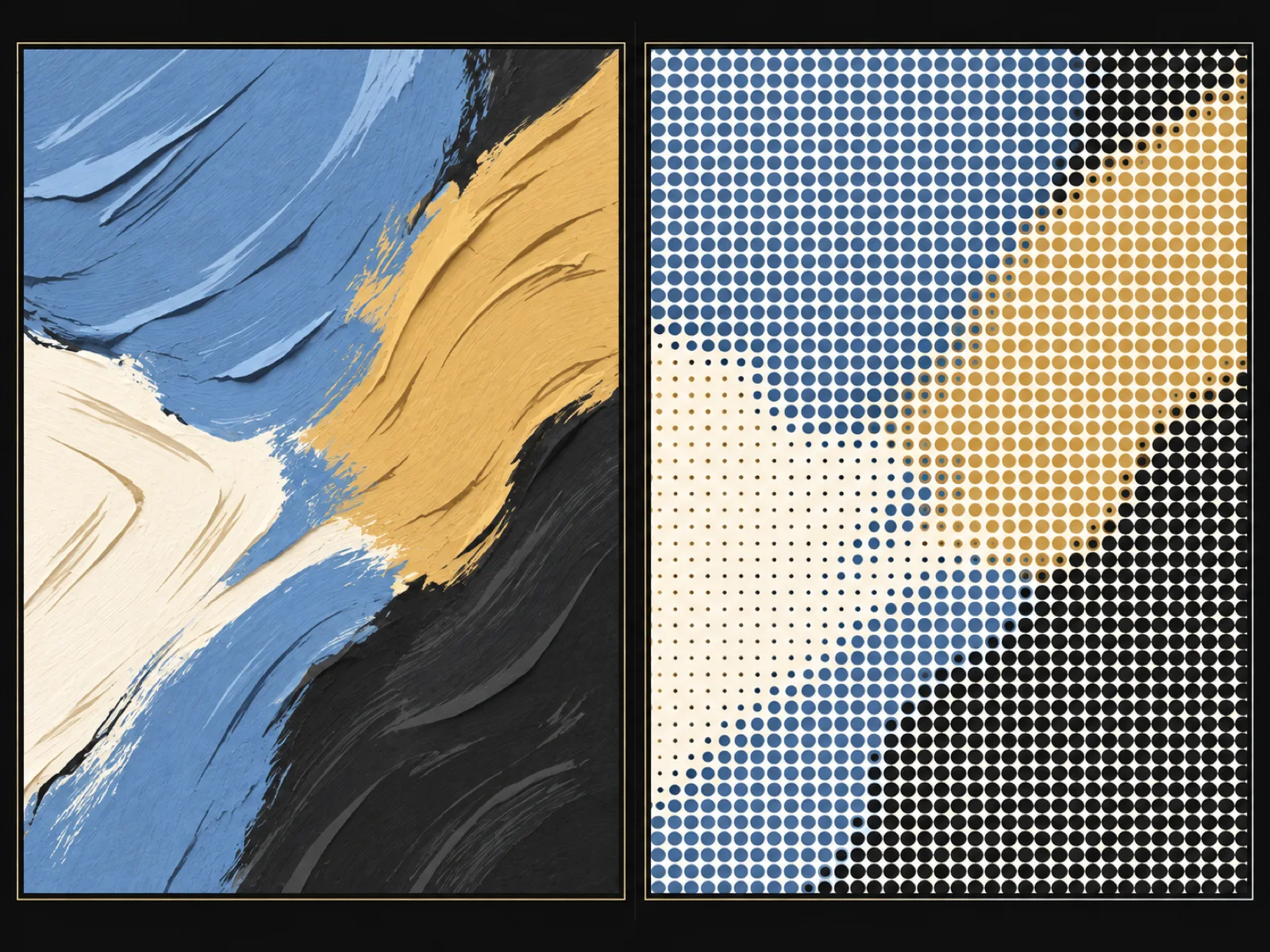
A framed picture that comes into your hands — inherited, thrifted, found in a spare room — raises one question before all the others: is it a painting or a print? The useful news is that the answer is usually visible, because the two things are physically different.
You do not need equipment beyond a phone torch and, if you have one, a cheap magnifier or jeweller's loupe. Work through the checks in order: each one narrows the answer, and the first decisive result usually ends the search. What none of them can do is authenticate an artwork — the last section says who can.
Why the answer usually isn't in the signature
The signature feels decisive and is usually not. Prints reproduce signatures along with the image — a signature sitting inside a printed dot pattern is ink on paper, not a painter's hand. Painted signatures get forged, added later, or read optimistically, so a name alone settles almost nothing.
Start with the surface and structure instead. They are harder to fake cheaply, and they answer the actual question: is there paint on this surface, or ink on it?
The margins tell a related story: commercial prints often carry lettering beneath the image — the publisher's line, 'after' a painter's name, or a plate mark — so check the border before the picture. Pencil signatures on prints often appear in the lower margin rather than inside the image, but they can sit elsewhere on the sheet — and where a signature sits establishes neither the medium nor the authenticity; the Clark Art Institute's guide to identifying a work lists inscriptions and marks as evidence to collect rather than conclude from. For what the marks themselves can and cannot establish — signatures, stamps, hallmarks, edition numbers — the marks guide goes deeper.
Raking light: does the surface stand up?
Conservators use raking light — a lamp held low and nearly parallel to the surface — to expose texture; it is a standard examination technique, and a phone torch does a passable job of it at home.
On a painting, brushstrokes cast their own tiny shadows: ridges of impasto stand up, thin glazes lie flat, varnish may show its own age cracks. Most reproductions answer with something uniform — flat ink on paper, or the mechanical regularity of canvas-textured stock. But 'flat' is not the print rule it sounds like: intaglio printing presses ink into raised ridges and embossing raises the paper itself — the V&A's teaching notes treat exactly those ridges as evidence of a print. Relief alone settles neither side, so read texture as one check among several. Texture that repeats identically in unrelated areas of the image is printed texture.
Paint behaves like landscape: brushstrokes leave ridges and furrows, and where two colours meet they are often blended by the brush itself. Printed 'texture' behaves like wallpaper — the same stipple whether it sits on a face or on a sky, which no painter would bother to do.
Dim the room. You want the raking light to be the strongest thing hitting the surface, so close curtains and kill overhead lamps.
Hold the light almost sideways. Bring a phone torch or small lamp down until it skims the surface at a very shallow angle — the flatter the better.
Sweep slowly and watch the shadows. Move the light across the picture. Raised brushwork sparks a moving line of shadow and highlight; a flat printed surface stays even. Some prints carry relief of their own — intaglio ink ridges, embossing — so a little texture is not proof of paint.
Check the edges. Texture on a reproduction often ends abruptly at the sheet edge or continues over a wrapped frame edge in ways real paint would not. Corners and margins are where printing betrays itself.
The loupe check: dots vs continuous ink
Most commercial reproductions — posters, art-book plates, mass-market prints — are built from halftone dots: a regular grid of tiny coloured points that blend into tones at normal distance. Under a loupe, or a phone camera zoomed to its limit on a mid-tone area, that grid is unmistakable.
Paint under magnification does the opposite: strokes stay continuous, colours blend wet-into-wet, and edges follow the brush rather than a grid. The Clark Art Institute's identification guide lists these surface checks among the first things to look for on an unknown picture.
Two honest cautions. Fine-art inkjet and giclée reproductions — especially on real canvas — lay down irregular ink with no halftone grid, so 'no dots' is not proof of paint. And some older print processes show dot patterns that look different again. When the checks disagree with each other, stop checking and hand the question to a specialist.
Compare areas while you magnify. In a real halftone print the dot grid stays regular even as tone darkens; in paint, a shadow area and a highlight area show genuinely different handling. Check the signature under the loupe last — if it resolves into the same dots as the image, it was printed with it.
No loupe? The phone camera's closest focus distance — or a 'macro' mode — resolves dots well enough on most prints. Hold the phone steady, brace it against the frame edge if needed, and check a mid-tone area rather than a dark or blown-out one.
Canvas edges and the back of the frame
The edges tell their own story — but only a supporting one. Originals and reproductions can both carry the image around the stretcher: painters do finish or wrap their edges, and 'gallery wrap' reproductions imitate exactly that. So the wrap itself settles nothing — what matters is what wraps: brushwork and paint texture on the edge, or the same uniform printed surface as the front. Look for tacks versus staples, and age-darkened wood versus fresh pine.
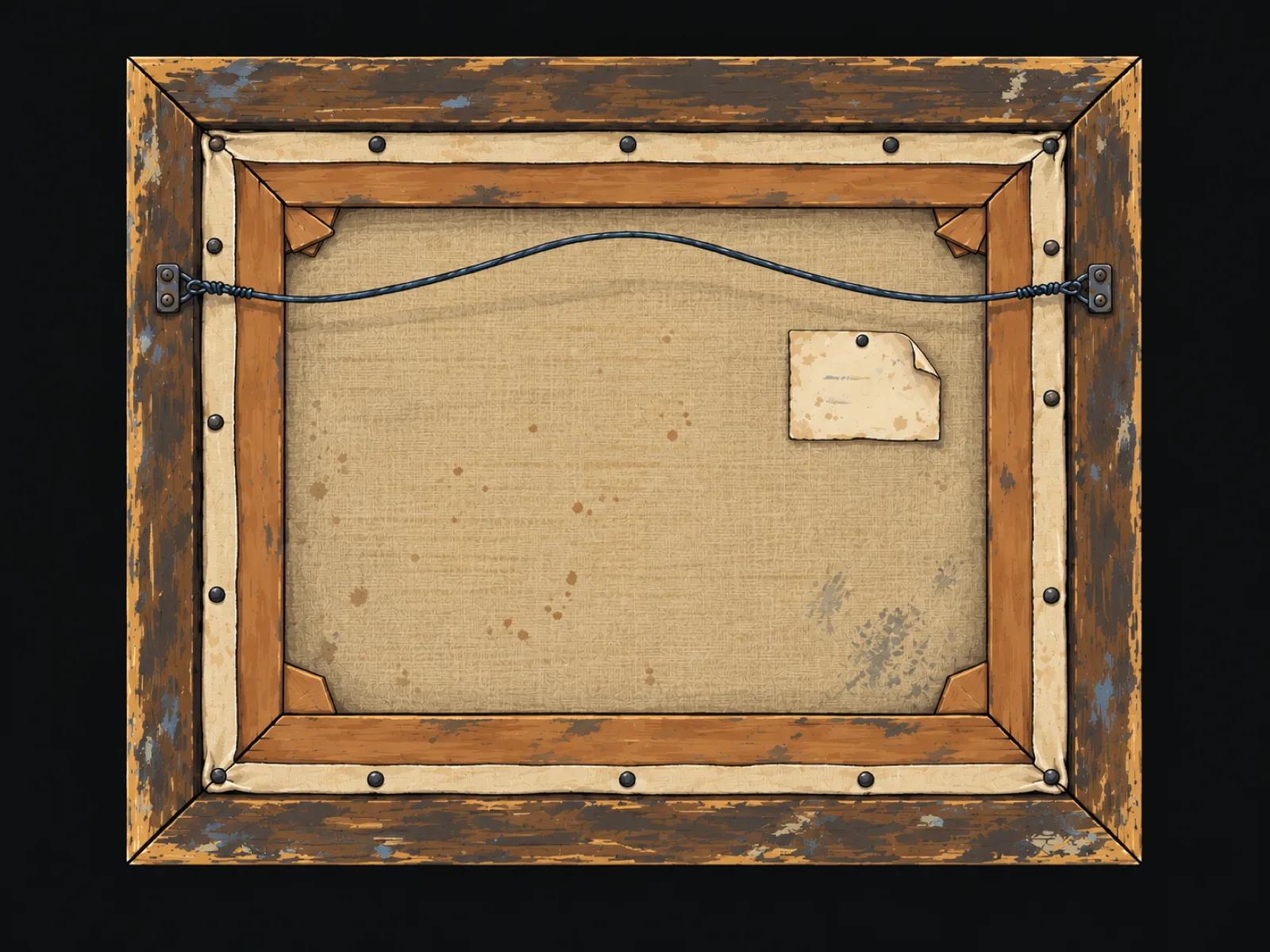
Then turn the frame around. The back carries the things nobody thinks to photograph: stretcher bars, old labels from framers, dealers, or exhibitions, handwritten notes, decades of dust that took decades to acquire. The V&A's prints collection and museum records treat exactly this material as evidence of what a thing is. Photograph all of it before touching anything.
Materials argue too. Paper under canvas-textured varnish is still paper; a board that claims to be canvas flexes like board. And consider the frame's history separately from the picture's — a nineteenth-century frame around a twentieth-century print is a common inheritance, and each half has its own evidence. Leave the assembly as found: peeling backing paper or lifting the work out of its frame destroys exactly that evidence.
What a photograph can show — and what it can't
A good photograph carries more of these checks than you might expect: a raking-light shot preserves texture, and a sharp close-up preserves dot patterns. So scanning the picture is a reasonable first move — the reading's surface and material notes tell you which of the checks above to run yourself. Compare how the Mona Lisa reading keeps its visible evidence and its documented context in separate layers; that is the same separation you are doing by hand.
The limit is equally plain: a photograph cannot prove paint, age, or authorship. It flattens texture cues, hides what's under varnish, and shows nothing about what's underneath the paint layer. The essay on why uncertainty deserves its own vocabulary and the site's methodology cover where that line sits and why it is drawn there.
When to stop checking and ask a conservator or appraiser
For the common cases — a poster in a smart frame, a print on textured board — the checks above settle it. Stop and escalate when they conflict: paint over a printed base, prints on canvas, mixed media, or anything where the answer changes what you would do next.
Before buying, selling, insuring, or donating on the strength of the answer, take it to a qualified professional. A conservator examines the object itself — microscopy, ultraviolet light, paint layers; an appraiser assesses value for a stated purpose. The American Institute for Conservation's directory lists conservators; the American Society of Appraisers keeps a find-an-appraiser directory. A photograph, a checklist, and a careful reading can narrow the question; only an in-person specialist can settle it.
A useful division of labour: a conservator answers 'what is this physically and what does it need?', an appraiser answers 'what is it worth for this stated purpose?'. Neither is a commitment — an identification conversation with a conservator is exactly the kind of question they field, and bringing your photographs makes it shorter.
And when you do escalate, bring the photographs you already made — front, back, labels, the raking-light shot. It is the same documentation a conservator or appraiser will ask for, and arriving with it makes the professional conversation shorter and cheaper to start.
Take another look
Try the raking-light check on one framed picture in your home. Then scan the front and compare what the reading says about the surface with what your own light showed.
Sources
- Clark Art Institute Library, Identifying a work of art (opens in a new tab)
- Victoria and Albert Museum, Prints collection (opens in a new tab)
- Victoria and Albert Museum, printmaking guidance (PDF) (opens in a new tab)
- American Institute for Conservation (opens in a new tab)
The checks are standard visual-examination practice, presented as Art Says Hi editorial guidance; they narrow a question and cannot authenticate a work. Sources last checked 2026-10-01.
Read a photo of your ownYour photo is only sent when you choose Start reading.
Spotted an error? Tell us