
Guide · Old paintings
Found an old painting? The first steps before asking what it's worth
Before value comes evidence. Photograph it, document it, keep the story straight — then the professionals have something to work with.
Old paintings surface in attics, estates, and charity shops — decorative works, reproductions, and occasionally something more interesting. What they share is fragile evidence: the frame, the labels, and even the dirt all carry information that casual handling can destroy.
This guide deliberately puts the value question last. Nothing here estimates worth, and no photograph — however good — can settle value or authenticity. What careful documentation can do is preserve everything a professional will ask for.
Don't clean it, don't reframe it
The most damaging moves are the tidy ones. Water, soap, erasers, oils, and household cleaners all remove more than dirt — grime sits in the same layer as old varnish and loose paint, and a well-meaning wipe can carry original material away. Flaking or lifting paint moves when touched. Leave it all exactly as found.
The same applies to the frame and fittings. Old labels, stamps, inscriptions, and even the frame itself are evidence; peeling tape, removing backing paper, or swapping the frame destroys context that specialists use to date and place a work. If the surface is dirty or unstable, that is a conservator's job — not a cleaning video's.
Think about where it waits, too. Damp garages, hot attics, and walls above radiators all keep damaging a painting while you research it. A stable room — dry, shaded, away from heat and handling — buys you all the time the next steps need.
Photograph the front, the back, the frame
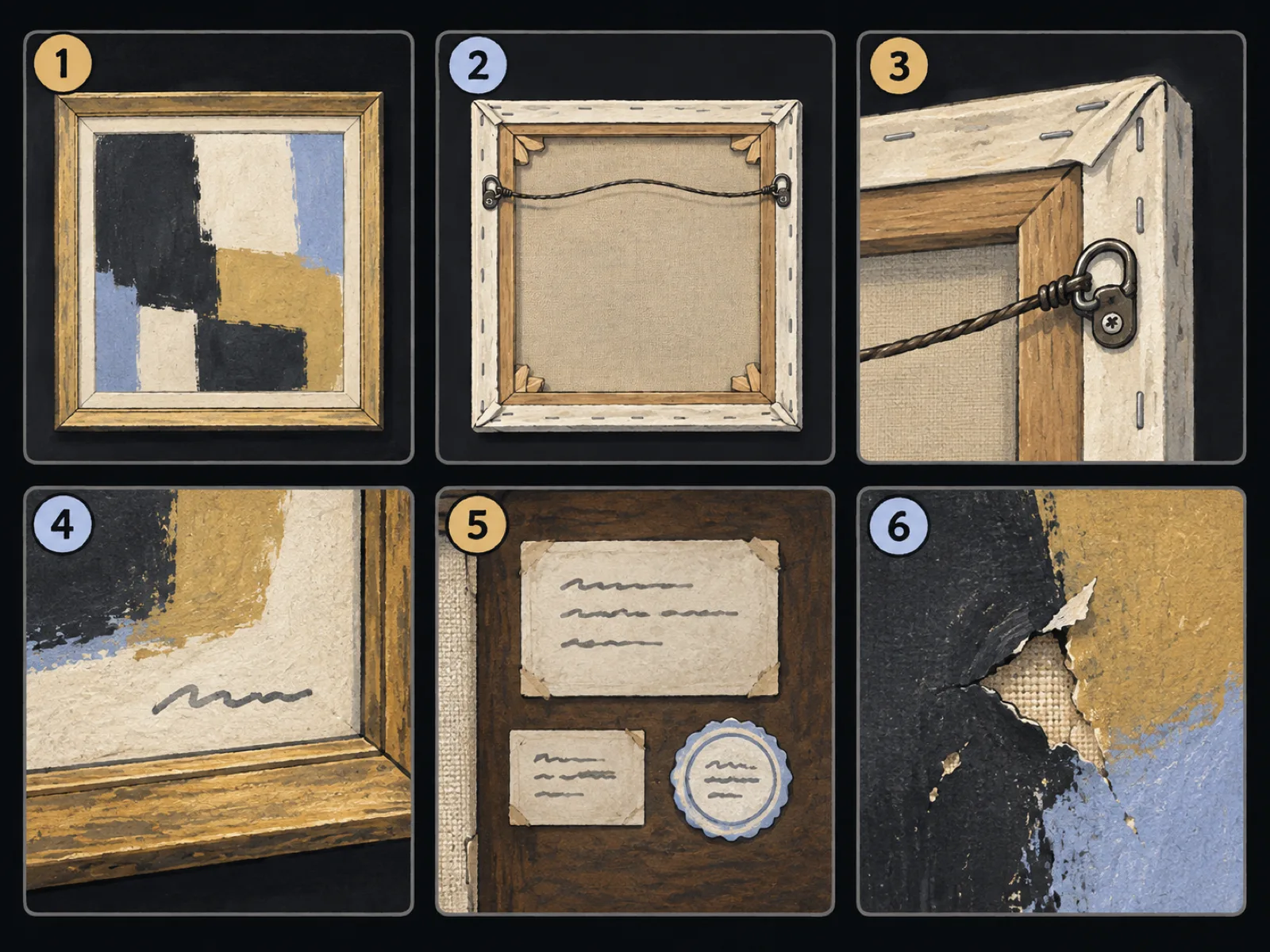
Good documentation is the cheapest protection the painting will ever get, and it is what every professional asks for first. Work through the six shots below — the photographing guide covers light, glare, and detail crops in more depth.
Why so thorough? Because found paintings move — estates disperse them, framers remove them from frames, relatives disagree about what was where. The photographs become the fixed record everything else is checked against, and they take twenty minutes.
The front, straight on. Even light, no flash, squared up so the edges run parallel. This is the reference every later conversation starts from.
The whole back. Stretcher bars, canvas or board, dust, and every sticker in one wide shot before any close-ups.
The frame and its hardware. Corners, hangers, wire, nails — the frame's age and fittings often date the assembly more honestly than the image does.
Every signature and inscription. Painted names, pencil notes, dates — photograph each one straight on, even the half-legible ones.
Every label and stamp. Dealer, framer, exhibition, and customs labels plus any inventory numbers. Each is a provenance lead.
Damage, up close. Tears, flaking paint, repairs, water marks. A specialist reads damage for both condition and age.
The frame and the backing have histories too
A painting's assembly is evidence in its own right. The Clark Art Institute's identification guide points to the stretcher as a dating clue — commercially manufactured stretcher bars suggest a later period than hand-built ones — and notes that a sheet of paper mounted on canvas tells a different story from paper alone. Marks can sit on the stretcher, on the back of the canvas, or on the reverse of a sheet: collectors' marks, dealer numbers, framer's labels.
The frame raises its own question: is it original to the painting, period-appropriate, or a later reframing? Each answer says something different — a dealer's frame tells you about the last sale, a dust cover or backing board about the last handling. A canvas relined onto a new stretcher, a cradle added to a panel, a board screwed on later: each intervention is part of the biography, not damage to hide.
Photograph all of it before anything moves, and resist 'improving' the assembly — reframing or stripping a backing destroys exactly the context specialists date works by. A frame that looks wrong for the painting is still evidence of when it was last sold or hung.
Collect every label, stamp and scribble
Treat every mark on the object as a sentence in its biography. Dealer and gallery labels place it in a shop; exhibition labels place it on a wall; framer's stamps place it in a city; handwritten notes — however cryptic — are somebody's memory of it. The Clark Art Institute's identification guide treats exactly these marks as the raw material of identification.
Photograph each mark, then transcribe what you can read into a note alongside the photo. Do not peel, lift, or 'flatten' any of them; a curling label survives best exactly where it is.
Chalk numbers on a frame's back are often auction-lot marks; stamped names are often framers or dealers; pencilled titles are often a later owner's guess. None of them is junk, and none of them is proof — they are leads, and leads are what the professionals in the last section actually work from.
The Clark guide's framing is useful here: collect marks as evidence to check, not conclusions to announce. A framer's stamp from a particular city is a place and date to test; a pencilled name is a hypothesis somebody left behind. Record them all, transcribe what's legible, and flag which readings are guesses.
Write down the story — and where it came from
Every found painting arrives with a story: where it hung, who owned it, where they said it came from. Write it down as you heard it, with names, dates, and the teller attached — 'my aunt said it came from her grandfather's hotel' is a lead, and a real one. What it is not is a fact, and keeping leads and facts in separate columns is the discipline that makes the story useful later.
That ownership history has a name: provenance. Gaps in it are normal, especially across wars, moves, and informal sales; the Getty Research Institute's provenance tools show what a documented chain looks like when one exists. The essay on why hedged words protect you is worth ten minutes before you repeat the story as fact.
And a small honesty note for the reverse direction: a camera alone cannot confirm provenance — labels and inscriptions are leads to check, not conclusions.
Real provenance research — the Getty's published tools and databases are the public-facing end of it — works backwards through sale records, exhibition catalogues, and dealer archives. Your job now is much simpler: don't let the story degrade between the telling and the writing. Dates shift, 'always in the family' shortens, and the unattributed detail that sounded like decoration turns out to be the identifying one.
Ask the specific questions while the teller is available: where exactly did it hang, who owned it before that, when was it framed, has it ever been cleaned or sold? Answers like 'it was already old when my mother was young' are worth writing down verbatim — approximate is honest, invented precision is not.
What a scan can add
Once you have the photographs, a browser reading can describe what is visibly there: the apparent medium, the style and period the image suggests, surface features worth a second look. It will use hedged language deliberately — the methodology explains why the evidence layer stays separate from interpretation. A scan that flags 'possible nineteenth-century landscape' is a pointer for a specialist, not a verdict.
Two things a scan cannot do: tell you what the painting is worth, or confirm who made it. If the reading looks wrong, the support page explains how to report it — every report is read, and confirmed errors are corrected.
Keep the reading's text with your photographs rather than treating it as a verdict — its hedged observations are exactly the kind of contemporaneous note that makes a later appraisal conversation faster.
Who to ask next: appraiser, conservator, auction specialist
Three different professionals answer three different questions. A conservator assesses condition and treatment — choose one through the American Institute for Conservation's directory. An appraiser produces a defensible value for a stated purpose — insurance, sale, donation — and the American Society of Appraisers lists accredited members. An auction house specialist gives a market view when selling is the question.
Whichever door you knock on, what they will ask for first is what this guide just made: clear photographs, a list of every mark, and the story with its sources. Value and authenticity are professional conclusions reached from evidence — and now you have some.
One distinction matters when choosing: an auction house's free estimate answers 'what might it make here, this season?', while a formal appraisal answers 'what is it worth for insurance, tax, or estate purposes?'. They are different documents for different decisions — and the auction estimate is the one that can start from photographs. Houses such as Christie's and Sotheby's accept submissions of clear photos, dimensions, and provenance notes, then give a provisional estimate subject to examining the work itself; it is a market view, not authentication. A formal appraisal is written for a stated purpose and standard, and authentication is a separate, harder question. All three start from exactly the file the earlier steps built.
Take another look
What did you actually find — and what did you only assume about it? When the documentation is done, scan the front for a first pass at what is visibly there.
Sources
- Clark Art Institute Library, Identifying a work of art (opens in a new tab)
- American Society of Appraisers (opens in a new tab)
- Christie's, auction estimates service (opens in a new tab)
- Sotheby's, estimate request guidance (opens in a new tab)
- Getty Research Institute, Provenance research tools (opens in a new tab)
Condition and provenance cautions follow museum conservation and provenance guidance; the checklist and photograph-then-research order are Art Says Hi editorial guidance. Sources last checked 2026-10-01.
Read a photo of your ownYour photo is only sent when you choose Start reading.
Spotted an error? Tell us