
Guide · Provenance
What is provenance, and why a photo can't supply it
Provenance is an artwork's ownership history — who held it, when, and how it moved. It is assembled from records, not read off the surface, and gaps in it are normal.
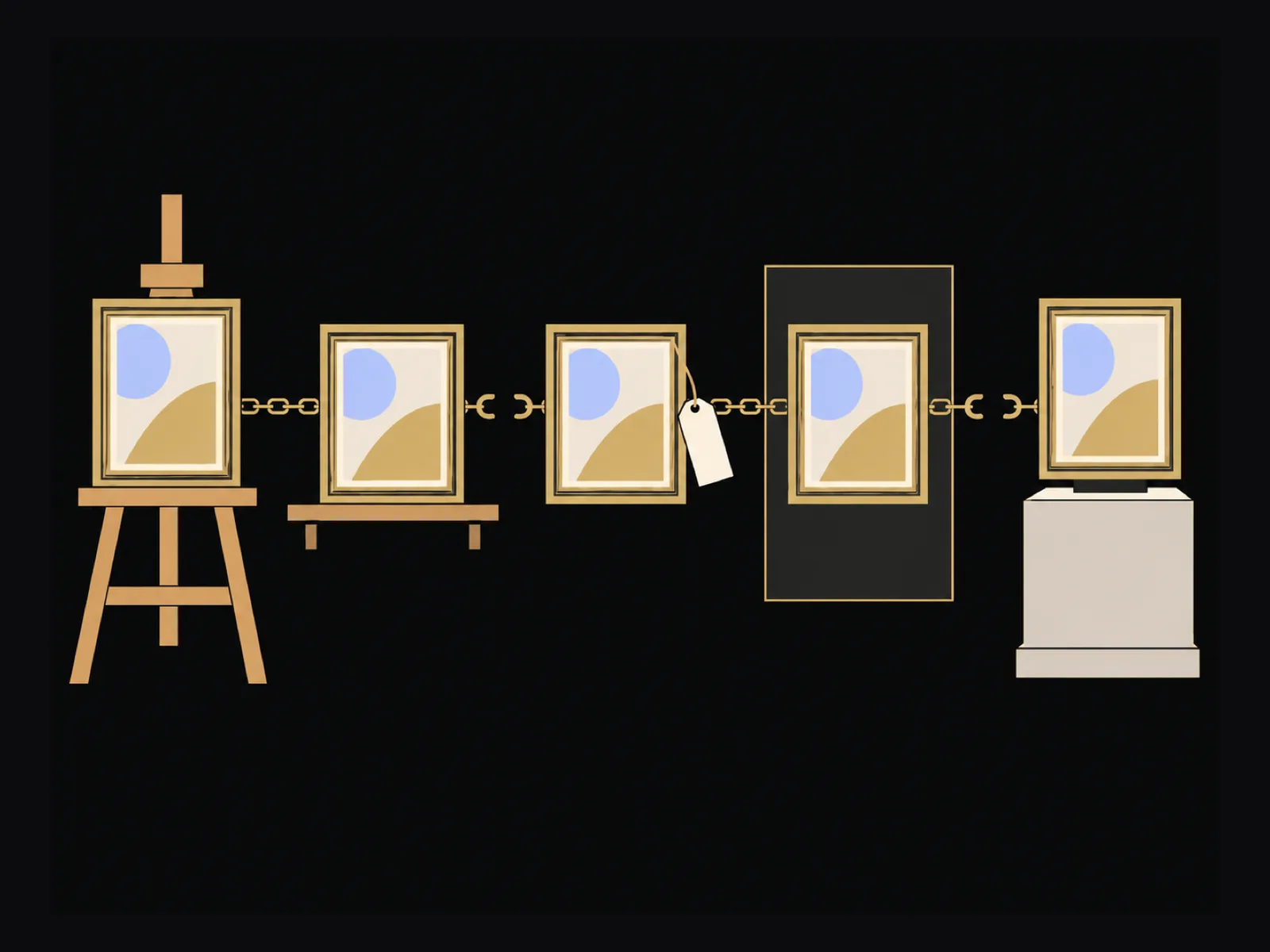
Every old object arrives with a history of hands: who commissioned it, who bought it, who sold it on, whose wall it hung on. That ownership history is the object's provenance, and for museum pieces it can be a documented chain reaching back centuries. For everything else it is usually thinner — a receipt, a story, a guess.
The distinction that matters is between 'this was in the Oppenheimer collection in 1932' and 'this has always been in the family'. One is checkable; the other is a lead. This guide explains what provenance is, where it is actually researched, and why a photograph — however good — can only find the marks that point at the records.
What provenance is
The Getty's plain definition: provenance is the ownership history of an artwork, from when it was first created to the present. The Met calls it the object's biography — its whereabouts in time and space. Either way, it is a chain of owners, dealers, sales, gifts, and bequests, not a description of the thing itself.
Two neighbours it is easy to confuse. Provenance is not attribution — who made the work — though the two lean on each other. And it is not the object's physical history — restorations, relinings, repairs — though conservators track that too. Provenance is only the chain of custody.
A documented entry in the chain typically names an owner or dealer, a date, and the transaction that moved the work: sale, gift, bequest, seizure. 'Collection of the Earl of X, by 1840; sold Christie's, 1912' is provenance. 'Probably French, nineteenth century' is not.
Why it matters
The blunt reason is legal: a museum — or a buyer — needs to know the work is actually theirs to hold. The decades around the Second World War get particular scrutiny, because the Nazi regime confiscated art on an industrial scale, and objects that passed through 1930s and 40s Europe sometimes carry a broken or forced link in their chain.
The Getty's own example is a limewood sculpture of St John the Baptist, taken from Jakob and Rosa Oppenheimer in 1933, sold at auction in 1937, and restituted to the family's heirs in 2011 — after which the museum could buy it in 2012 with clear title. The provenance is what made that outcome possible.
The quieter reasons are scholarly. Knowing when a work sold and to whom maps the art market of its moment; knowing that the Rothschilds owned a commode tells you what that family's taste valued and who might have seen it. Provenance is how objects keep their receipts — and museums publish it on object pages precisely because it is part of the work's meaning.
Where provenance research happens
In archives, mostly. The Getty Provenance Index alone holds more than twelve million digitised records: dealer stock books from firms like Goupil and Knoedler, sales catalogues documenting works offered in Europe between 1650 and 1945, and inventories of private collections running back to 1520. It exists so that a name in a margin can be matched to a sale.
Researchers work backwards through exactly those materials — auction catalogues, exhibition lists, dealer archives, estate inventories, customs records — plus the object's own labels and stamps. Increasingly the results are public: museums print provenance lines on object pages, and databases like the Index are open for anyone to search.
For a private object, the starting material is humbler but shaped the same: receipts, letters, insurance papers, auction stickers, the framer's label on the back of the frame. The first-steps guide for a found painting covers how to collect and photograph that evidence without disturbing it.
Why a photo can't supply it
Because the chain lives in documents, not on the surface. A camera can record what a provenance researcher will want to see — the dealer's label, the auction-lot chalk mark, the inventory number, the collector's stamp — but each of those is a lead into the records, not a link in the chain itself.
This is where image readings earn their keep and hit their limit at once. An AI-generated scan can describe and transcribe visible marks — provisionally, as a draft to check; it cannot tell you whether the collection named on a label actually held this object, or whether the label is even contemporary with the work. The guide to what marks can tell you goes deeper on reading the marks themselves.
The honest division of labour: the photograph preserves the evidence, the archive tests it. A reading that claims provenance from a photo alone is claiming something the medium cannot carry — which is why a reading here marks whether such claims were checked against an outside record — the methodology explains the layers it is sorting between.
Gaps are normal
Real provenance is almost never complete. The Met is direct about it: for an object going back to antiquity there may be centuries-long gaps, and researchers mostly focus on the most recent decades. Every old object spent some of its life undocumented — hung in houses, passed through hands, recorded nowhere.
A gap is not an accusation. It becomes a question only when it falls in a period that should have produced records — the 1933–45 gap in European ownership being the canonical example — or when the documented parts do not hold together.
So read a provenance line like a chain, not a verdict. Solid links, honest gaps, and the occasional 'possibly' — the uncertainty essay explains why hedged words are a feature, not a dodge.
Provenance and attribution are different questions
A strong pedigree supports an attribution without proving it. The Getty's own example is a bronze Double Head owned by Louis XIV, the financier Pierre Crozat, and the author Quintin Craufurd — and at some point in the 1700s it was misattributed as a Roman antiquity rather than a Renaissance sculpture. Impeccable owners, wrong label.
The reverse is also true: a work with no provenance beyond last Tuesday can still be exactly what it looks like. Most objects that exist were never important enough to document continuously, and absence of paperwork is not evidence of forgery — it is absence of paperwork.
Where the two questions meet is in the marks: signatures, stamps, labels and inscriptions are where the ownership chain touches the object physically. The marks guide covers what each kind can and cannot establish.
Questions to carry into a listing or label
When a listing, label or catalogue entry mentions provenance, a few questions do most of the work. Does it name actual owners, dealers or sales — or just an aura ('from an old collection')? A line that can be checked is worth more than a paragraph that cannot.
Does it cover the decades that matter? For European objects, the 1933–45 period is the obvious scrutiny zone, and a chain that goes quiet exactly there deserves a follow-up question rather than a shrug. Does it cite its own sources — a catalogue raisonné entry, an auction lot number, an inventory — or assert without them?
And where the record runs out, does it say so? A line that ends 'possibly' is being honest about a gap — while a phrase like 'by descent' describes how the work moved, by inheritance inside a family, and says nothing about how well it was documented; the paperwork behind it may be complete or missing. Treat the honest gap as normal and the overclaim as the warning sign. The essay on hedged words is the companion read here.
When provenance becomes a specialist's job
Hand it over when the stakes are real: a suspected wartime displacement, a high-value purchase or sale, an insurance claim, an estate, or a nagging gap in exactly the decades that matter. Provenance researchers, museum departments, auction-house specialists and, where title is disputed, lawyers are the routes — roughly in that order.
Bring the same file you would bring any professional: clear photographs of the object and every mark, the story of how it reached you with names attached, and whatever paperwork exists. The first-steps guide has the collection routine.
And for the owner of an ordinary object with an ordinary gap, the reachable work is simpler: write down what you know, keep the labels on, and resist upgrading 'my aunt said' into 'documented'. Future researchers — including the future you — will thank you for the honesty.
Take another look
Next time a museum page lists a 'Provenance' line, read it backwards — from the museum to the maker — and count the gaps. Then look at your own object: its labels and inscriptions are where a chain could begin. An AI-generated scan can help you read them — a provisional first pass on the marks, not a test of the chain.
Sources
- Getty, What is provenance? (opens in a new tab)
- Getty Provenance Index (opens in a new tab)
- The Metropolitan Museum of Art, Provenance research: art detective (opens in a new tab)
Historical examples are drawn from the institutions' own published accounts. Sources last checked 2026-10-01.
Read a photo of your ownYour photo is only sent when you choose Start reading.
Spotted an error? Tell us