
Guide · Prints
Why the same print looks different in every museum
Two museums show the Great Wave in different colours, and both are right. Prints are multiples — and impressions, editions and photographs each change what you see.
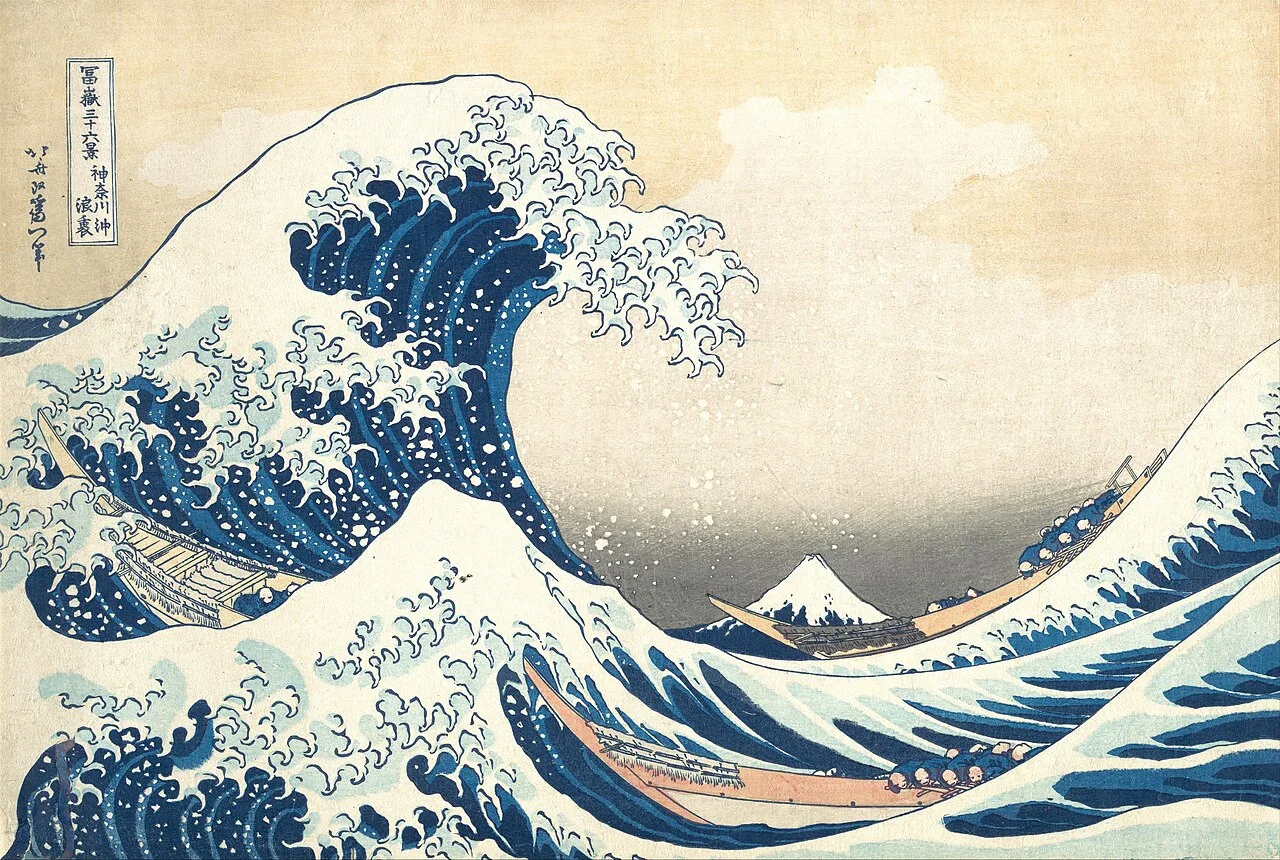
Look up the Great Wave in three museum collections and you will find what looks like three prints: a bright blue sea here, a softer one there, different skies, different crispness of line. All of them are genuine. A print is not a single object the way a painting is — it is an image made on one surface and transferred to another in a repeatable process, so the work exists as many impressions.
This guide explains where the differences come from — impression, edition, state, age, and finally the photograph you are looking at — and why 'which one is real?' is the wrong question to ask.
One block, many impressions
The V&A's primer is the cleanest definition: a print is 'an image created on one surface, and transferred to another, in a process which is repeatable' — which is exactly why multiple impressions exist. The same woodblock or plate can print pull after pull, and each pull is the work. The V&A's print collection alone runs to around half a million works, Japanese woodblock included.
The Great Wave is the famous case. Published around 1830–31 as part of Hokusai's Thirty-six Views of Mount Fuji, it survives in impressions scattered across collections — the Art Institute of Chicago alone holds three. What changes between them is not authenticity but history: when the sheet was pulled, how much life the blocks had left, and what has happened to the paper since.
The site's Great Wave example reproduces the Metropolitan Museum's impression — held beside the Art Institute's, the colours will not quite match. That gap is the subject of the rest of this guide.
Edition, state, reprint
Three words do most of the sorting. An impression is a single pull from the matrix. An edition is a managed run — the pencil fraction '14/50' on a modern print means impression fourteen of a limited fifty, though the V&A notes edition sizes are limited by the process and materials or set artificially for commercial reasons. A state is a change to the matrix — recut lines, added or altered blocks — that makes printings before and after it visibly different.
Then there are reprints and later editions: pulls made after the first run, sometimes decades later, sometimes from worn blocks. They are not forgeries — they are the object continuing its production history. The Art Institute presents its three impressions as a comparison worth looking at closely: all later than the first state of the design, each visibly its own sheet.
The practical check: the marks guide covers edition numbers and inscriptions on the sheet itself, and the catalogue record carries the state and printing history when it is known.
Fading, paper and mounting
Two impressions printed from the same blocks can still look different because paper and pigment age differently. Light is the big agent: the Art Institute's curator notes that Japanese woodblock prints are especially sensitive to prolonged exposure, which fades colours and damages the paper — the museum displays each impression for only a few months at a time for exactly that reason.
Paper tone, stains, trimming and old mounts shift what you see too: an impression trimmed to the image reads differently from one keeping its margins, and the colour of the sheet moves every colour printed on it. None of this makes one impression fake — it makes each copy a record of its own life.
The photograph of the print is another layer
Before you ever stood in front of the paper, you saw a photograph of it. Museum photography adds its own interpretation — lighting, white balance, cropping, compression — so two websites can show the same impression differently too. Part of the colour gap you noticed may live in the photo, not the print.
That is worth holding loosely: a museum image of an impression is evidence of that impression, processed through the camera's choices. The camera essay makes the general case for treating photographs as evidence with limits.
Which version is 'real' is the wrong question
The V&A states it plainly: 'the original work of art is the print itself, rather than the block or plate from which it is printed.' Every true impression from the matrix is the work — the differences are history, not counterfeit.
The better questions are the ones a record can answer: which state is this impression, how early in the printing, what condition is the sheet in, and how has it been kept? Value and rarity ride on those answers — which is a specialist question, and this site does not offer estimates.
Compare two impressions yourself
Open the site's Great Wave example — its credited reproduction is the Metropolitan Museum's impression — beside the Art Institute of Chicago's record (opens in a new tab) for its own impression, and list what changes: sky tone, foam detail, line sharpness, paper colour. Two documented impressions, two collections.
Then try a travel poster the same way, or scan a print or poster you own and compare the AI-generated, provisional reading's description against a museum impression. The poster guide covers the lithographic side of the same family.
Take another look
Next time an image you love looks different somewhere else, check whether it is a print — the difference may be the story, not a mistake. If you have a print or poster of your own, scan it and see how the AI-generated reading describes what it can only partly settle — provisional by design.
Sources
- V&A, What is a print? (opens in a new tab)
- V&A, Prints collection (opens in a new tab)
- Art Institute of Chicago, Seeing triple: the Great Wave (opens in a new tab)
- Metropolitan Museum of Art, collection record: Great Wave impression (opens in a new tab)
- Art Institute of Chicago, collection record: Great Wave impression (opens in a new tab)
- Library of Congress, travel posters guide (opens in a new tab)
Print terminology follows the V&A's definitions; the Great Wave claims follow the Art Institute of Chicago's documented impressions and the Met's collection record. Sources last checked 2026-10-01.
Read a photo of your ownYour photo is only sent when you choose Start reading.
Spotted an error? Tell us