
Guide · Museum labels
How to read a museum label (and when to read it last)
Six lines of small type hold the work's maker, title, date, medium, credit, and accession number. Learn the order they come in and any wall becomes readable.
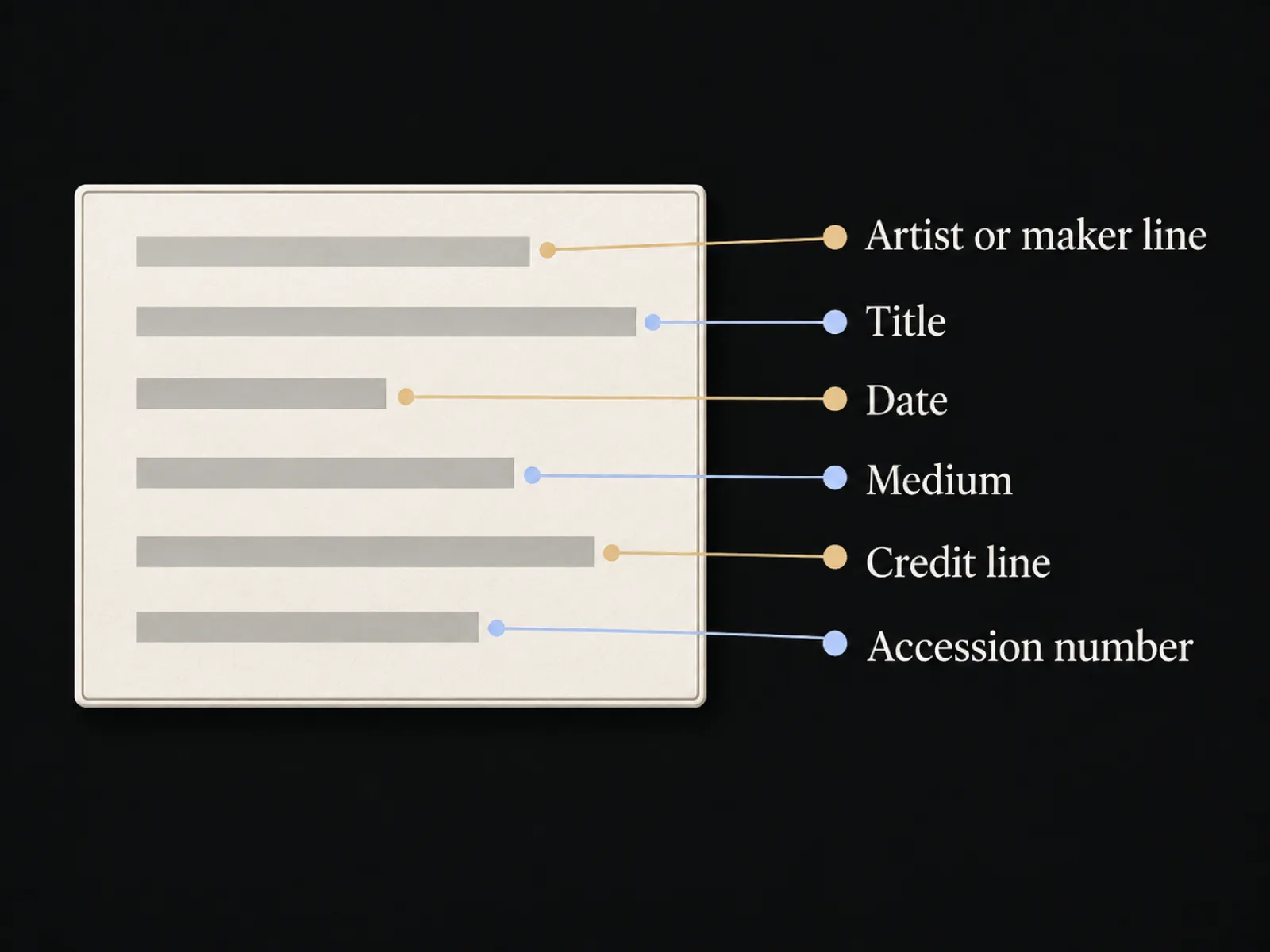
A museum label is a compressed database record wearing polite typography. The same fields appear in nearly the same order on walls around the world, because they answer the questions every visitor asks, in the order visitors ask them.
The open question is when to read it. The short answer: the label is a wonderful second move and a mediocre first one — the reasons are below, with the anatomy itself first.
The anatomy of a label
Read top to bottom. The artist or maker line comes first: name, life dates, nationality or culture — the who. The title follows, often in italics; descriptive titles were sometimes given by later owners, not the artist. Then the date — watch for 'c.' or 'about', which are the museum saying its certainty out loud. The medium ('oil on canvas', 'gelatin silver print') names the physical stuff you are looking at. The credit line records how it got there — gift, purchase, bequest. And the accession number, usually a string like 63.198, is the object's permanent ID inside the collection.
Most museums also divide labour between two label types: the tombstone label carries just these fields, while extended wall text adds a paragraph of interpretation. Knowing which you are reading tells you whether you are being offered facts or an argument. The Art Institute of Chicago's and the Terra Foundation's guides to label anatomy walk through the same fields.
Some exhibitions add a third kind: the section or room panel that introduces a whole wall at once. Reading it first costs little and frames every smaller label in the room.
For the qualifier inside the artist line — 'attributed to', 'circle of' — that is its own vocabulary, covered in the guide to attribution terms.
The format flexes — QR codes, digital labels, object-less wall text — but the field order survives almost everywhere, because it is the order of the questions people actually ask.
Two small conventions to know while reading: 'c.' or 'about' before a date is the museum saying the year is approximate, and titles in brackets or quotation marks often mark a descriptive title the artist never gave the work. Small marks, but they separate what the institution knows from what it supplied for convenience.
Accession numbers and credit lines
The accession number is the most useful line nobody reads. It is the object's permanent ID inside the collection, and it is the search key: type it into the museum's online collection and you get the full object record the wall could not fit. Many museums build a year into it — the Terra Foundation's own label example, 1992.163, marks a painting that became the 163rd object to enter its collection in 1992 — but that year records when the museum registered the object, not necessarily when it was acquired, and plenty of numbering systems carry no year at all. Quote it in any question to the museum and you are speaking the registrar's language.
The credit line is a compressed thank-you and a quiet provenance hint: 'Gift of', 'Bequest of', 'Purchased with funds provided by'. Museums negotiate these words precisely, so they record real history — whose collection it came from, and occasionally why.
Formats vary between museums — some use year-and-number, others running or older proprietary schemes — so don't over-read the digits; when you need to decode one, that museum's own numbering convention is the authority. What stays constant is the function: one stable identifier for one object, across catalogues, loans, and research.
Borrowed works wear the same line in a different voice: 'Lent by' or 'On loan from' names the lender rather than recording a gift or purchase, and it quietly warns that the object may not be there on your next visit.
Look first or label first — a working answer
The debate is real: labels risk telling you what to see before you see it, and a wall of text can substitute reading for looking. The working answer most museum educators land on — and the one the guide to looking at art uses — is look first when the work is new to you, label when you want to check a hypothesis or learn a category.
Practically: give the work a minute of your own attention first. Note what you think it is, what it is made of, what it might be about. Then read the label as a check on your looking — agreement is satisfying, disagreement is interesting, and both teach more than the label alone would have.
There is a crowd corollary too: in front of a famous work, the label is often unreachable anyway. Looking first is not just the better discipline — sometimes it is the only available one.
What the label leaves out
A label is a selection, and knowing its silences makes it more useful. It carries no condition report, no full provenance, no price, and it compresses attribution debates into one word — 'attributed to' hides the argument that word is standing on. Extended texts choose one interpretation where several exist.
The fuller record lives in the museum's collection database, reachable through the accession number — that is why the small string of digits is the most powerful line on the wall.
And labels have authors. They are drafted by curators, edited by teams, and constrained by word counts and house style — which is why reading them as one institution's selected account, rather than the whole truth of the object, is the accurate habit.
None of this is a criticism of labels — compression is what makes a wall readable at a glance. The point is that the accession number and the credit line are there precisely because the record continues off the wall, and the label is an index into it.
Using the label with your phone
Photograph the label after the work, not instead of looking at it: the label shot is evidence — title, date, accession number — that survives the visit. Photography rules vary, so check signage; the National Gallery, for instance, permits personal non-commercial photography unless a sign says otherwise.
Then compare records. Scan the work and put the reading's documented-context layer next to the label: agreement builds confidence, and any disagreement is a genuinely interesting question rather than an error. The methodology explains what the reading's context layer is drawing on. You can see the same pairing worked through in the Las Meninas example. Most museum sites publish the object's image alongside the record too — often under a licence you can reuse; the guide to open museum collections shows where.
One habit worth building: photograph the label immediately after the work it belongs to. In a day's photos the pairing then survives — the frame that follows a work in your camera roll is its label.
Try it on your next visit
One room, one work, five moves — about four minutes.
The whole sequence fits inside one gallery visit — and once the label's structure is familiar, the same order of reading works on the museum's website and in its catalogue, where the same fields reappear at greater length.
Look before you read. Give the work a full minute first. Form your own guesses about what it is, what it is made of, and what it might be about.
Read top to bottom. Artist, title, date, medium, credit line, accession number — each line answers one question. Notice which line answers the one you were actually carrying.
Check the attribution word. Is it a confident 'by', or a qualified 'attributed to' or 'circle of'? The qualifier is the museum's confidence level written small.
Photograph the label if allowed. A quick legible shot preserves the accession number and credit line for looking up later — the wall never makes it home otherwise.
Look the object up afterwards. Search the accession number on the museum's collection site, or scan your photo of the work and compare its context layer with the label's.
Take another look
Think of a label you skimmed recently — which line would have answered your real question? Next visit, scan the work and set the reading's context beside the label's.
Sources
- Art Institute of Chicago, How to read a label (opens in a new tab)
- Terra Foundation, How to read an art label (opens in a new tab)
- National Gallery, Plan your visit (opens in a new tab)
Label anatomy and the look-first discussion are Art Says Hi editorial guidance; field conventions vary between museums. Sources last checked 2026-09-29.
Read a photo of your ownYour photo is only sent when you choose Start reading.
Spotted an error? Tell us