
Guide · Catalogue records
What a museum catalogue record tells you — and how to check it
Accession numbers, credit lines, provenance rows — an object record is the museum's file on the thing you just looked at. Which fields carry the weight, and how to read them without over-trusting them.
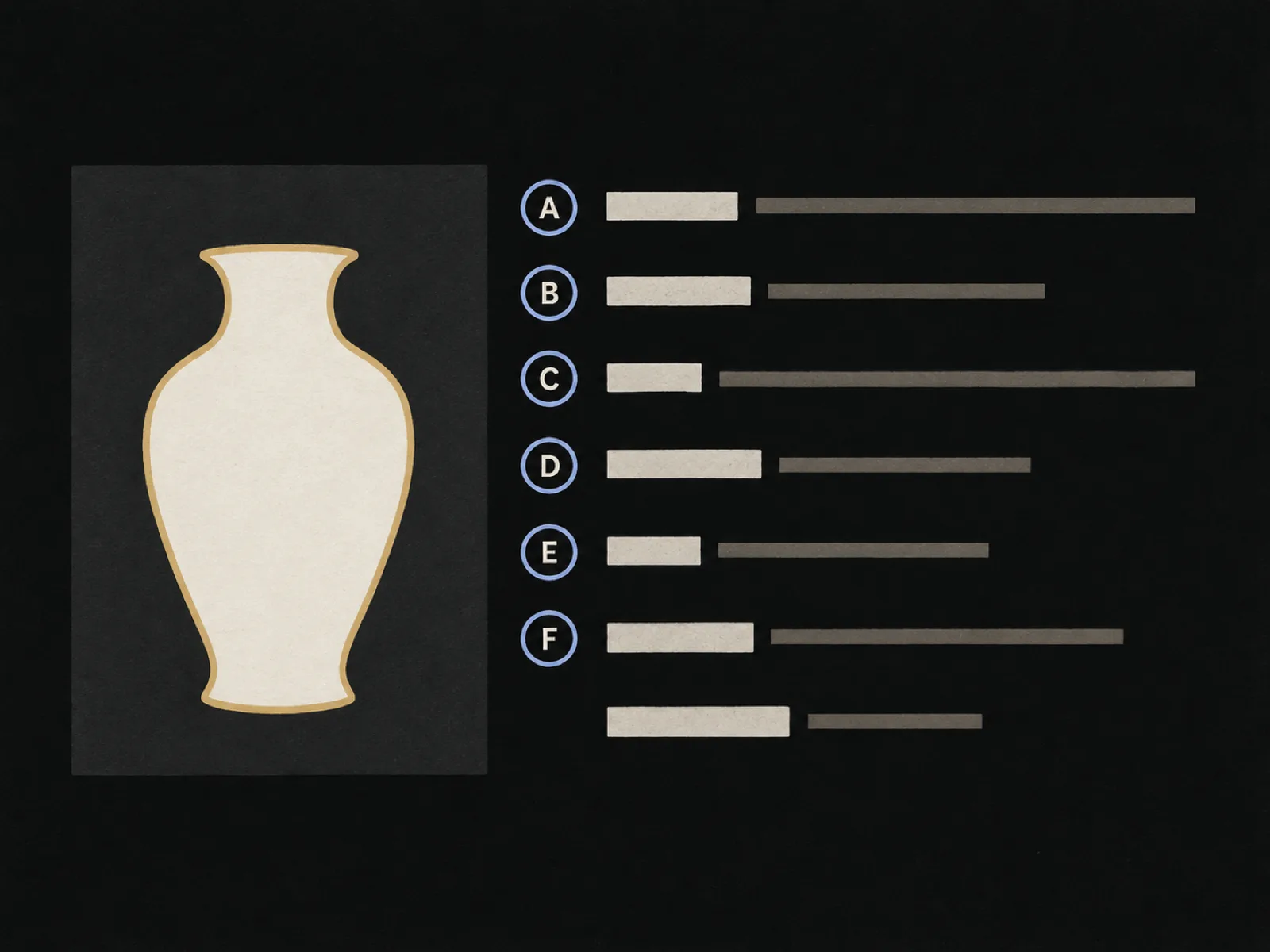
Every example page on this site ends by pointing at an institutional record — this guide is about reading that page when you land on it. A catalogue record is the museum's file on the object: what it is, who made it, when, what it is made of, and how it arrived. It is the documented-context layer made visible.
The Louvre's record for the Mona Lisa is the running example below because it demonstrates the whole pattern on the world's most famous painting: two inventory numbers, a formal title that is not the famous name, a date range rather than a single year, and an honest caveat that its contents may not reflect the latest state of knowledge. If a record this scrutinised still hedges, every record hedges.
Where records live: object pages and collections databases
The holding museum's own collections site is the first place to check: the Louvre's collections database, the Getty Museum's collection, and the Art Institute of Chicago's collection all publish object records free of charge. Some institutions expose the same records as machine-readable data for developers — the AIC runs a public collections API alongside its object pages.
The same object can surface in several places — the museum's catalogue, a catalogue raisonné, an aggregator site. When accounts differ, the holding museum's own record is usually the authority of first resort: it is the institution answerable for the physical thing.
A record is also what this site's context is drawn from: the sources at the foot of every example page are records like these, and an AI-generated reading's documented-context layer aims at the same material — provisionally, since the sources a reading lists are references it drew on, not records it independently checked. Learning to read the source is learning to check the summary.
The fields that carry weight
A record is a file of fields rather than a prose answer, and each row answers a different question. Title: the museum's formal name for the object — often not the popular one. Maker: the artist line, including qualifiers. Date: a single year, a range, or a period. Medium and dimensions: what it physically is. Inventory or accession number: the object's permanent address inside the museum. Department, current location, and credit line: where it lives and how the museum acquired it.
The fields are not equally stable. Identifiers and physical facts — inventory number, medium, dimensions — change slowly and survive catalogue overhauls. Descriptive fields — title, subject, sometimes attribution — are the ones a museum rewrites as knowledge moves. When you check a claim, weight it accordingly: a disputed attribution is a live question; a digit transposed in a dimension is a typo.
On the Louvre's Mona Lisa record, for instance, the formal title is “Portrait de Lisa Gherardini, épouse de Francesco del Giocondo, dit La Joconde ou Monna Lisa” — the famous name survives inside it only as the ‘dit’, with ‘La Joconde’ carried as the title of use.
Provenance and exhibition history lines
Provenance is the ownership chain — the list of hands an object has passed through — and the provenance guide covers what it can and cannot establish. Exhibition history lists where the work has been shown; bibliography lists what has been published about it. These rows are records about records: each cites an external event or publication that can, in principle, be checked further.
Gaps are data, not defects. A provenance that jumps a century is the museum recording a missing link honestly. And the hedged wording inside the Louvre record rewards attention: the portrait was “commencé vers 1503 au moins, sans doute” for Francesco del Giocondo, and “très probablement” acquired by François I in 1518 — probably, without doubt's shadow, in the record's own words.
Records also map their own neighbourhood. The Louvre's Mona Lisa notice links two further records both typed as copies: a seventeenth-century La Joconde (inventory MNR 265) whose maker line reads ‘d'après’ Leonardo, and a nineteenth-century version by Gabriel Ferrier (RF 2005 8). The catalogue itself is showing you the versions any identification would have to distinguish.
What ‘attributed’ and ‘unverified’ mean in a record
Record language mirrors label language: the qualifiers the attribution guide decodes on the wall — attributed to, workshop of, after — appear in the maker line of a record with the same weight. ‘Attribution actuelle’ on the Louvre record means the museum's current attribution: a position, not a guarantee carved in stone.
Some records flag their own freshness directly. The Louvre's Mona Lisa page stamps its own ‘dernière mise à jour’ and adds that the content does not necessarily reflect the latest state of knowledge — the record admitting, in its own words, that it is a snapshot.
An old record is dated, not wrong. Museums revise records as research moves, and the fastest-drifting fields are the practical ones — the Louvre's page notes that room locations may lag while its collections tooling is overhauled, so ‘Salle 711’ today could be a stale pointer tomorrow. Re-check records you rely on, and keep the URL: the ARK address is the permanent anchor.
Checking a claim against the record
A claim is checkable when it maps to a field. These are five moves you can run on any record yourself — the same discipline the site's example pages apply when they source their documented context.
Match the claim to a field. Every claim belongs to exactly one field: ‘it's by da Vinci’ is the maker line; ‘early sixteenth century’ is the date; ‘oil on poplar’ is medium and support. A claim that matches no field is context or interpretation wearing evidence's clothes.
Check the record's own date. Find the last-updated or modified stamp. A record refreshed recently and one untouched for years carry different weights — not because the older is wrong, but because it speaks for an older state of knowledge.
Follow the inventory number. The accession or inventory number is the object's address inside the museum. The Louvre's Mona Lisa carries two — INV 779 as the main number and MR 316 as an older inventory number — different numbering eras attached to the same physical object.
Read the linked records. Related notices matter as much as the main entry. The copies and versions a catalogue links show you what a claim must beat — on the Mona Lisa record, the two linked ‘Copie’ notices are exactly the objects a would-be ‘original’ elsewhere has to be distinguished from.
Disagree precisely. When what you see and what the record says differ, name the field you dispute. ‘The record says 1510; the stretcher construction suggests later’ is a question a curator can act on. ‘I don't think it's real’ is not.
Try it: the Mona Lisa's Louvre record
Open the record — collections.louvre.fr, notice cl010062370 (opens in a new tab) — and run the field walk. The maker line carries the full name (“Léonard de Vinci, Leonardo di ser Piero da Vinci, dit Leonardo da Vinci”) beside an ‘École de’ line reading Italie; the date gives “1e quart du XVIe siècle (1503–1519)”; the medium is oil on poplar; the department is the Département des Peintures, currently shown in the Salle de la Joconde.
Then compare it against this site: the Mona Lisa example links the same record from its sources, and the methodology page explains where record facts sit inside a reading — documented context, never blended with what the image shows. Once you can read the source, you can audit every summary built on it.
Take another look
The next time a claim about an object matters to you, trace it to the record and name the field it lives in. If it lives in no field, it was never the record's claim. An AI-generated reading gestures at this same material in its context layer — a provisional summary, not a checked record — and now you can audit the summary.
Sources
- Mona Lisa object record (Musée du Louvre collections) (opens in a new tab)
- Collection (Getty Museum) (opens in a new tab)
- Collection (Art Institute of Chicago) (opens in a new tab)
Field conventions vary between museums; the Louvre record is the worked example and the other collections linked show the same pattern at different institutions. Sources last checked 2026-10-01.
Read a photo of your ownYour photo is only sent when you choose Start reading.
Spotted an error? Tell us