
Designed objects · Discovery
Design referenceBraun SK 4
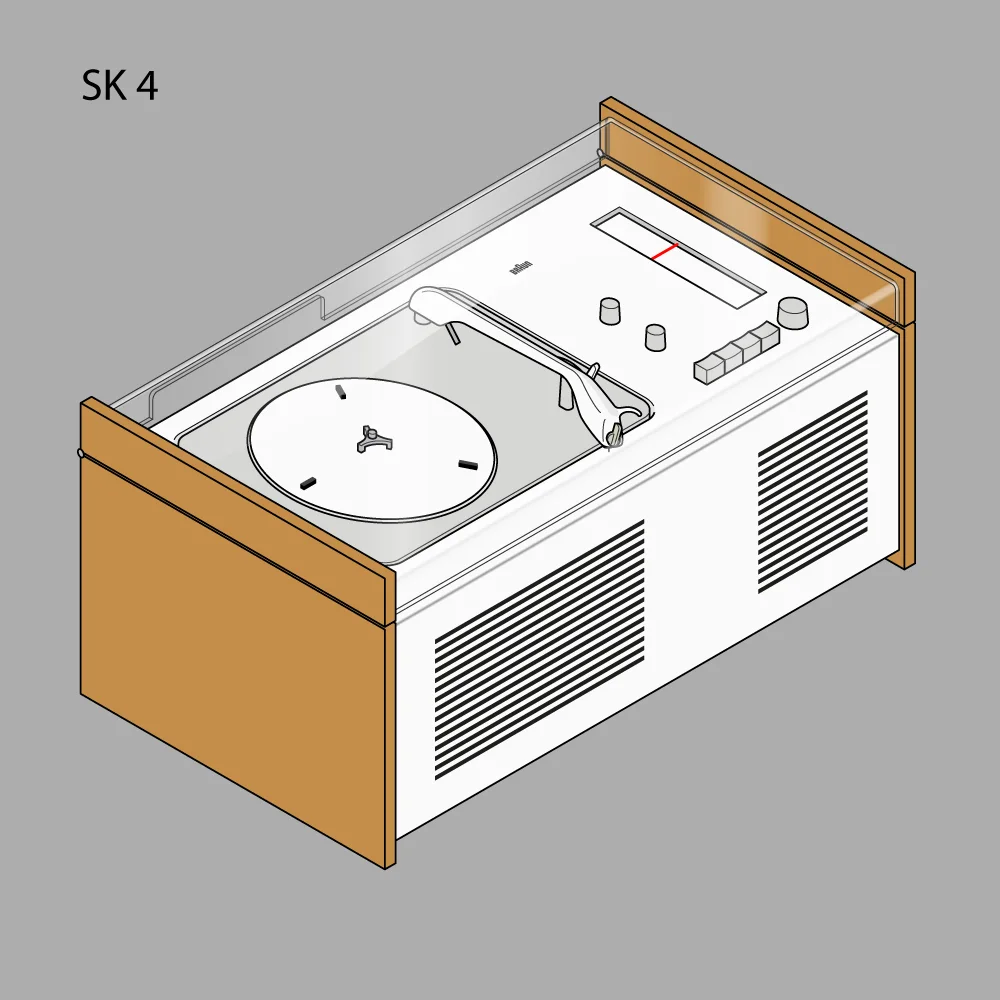
A clear-lidded radio and record player where control is expressed as a quiet rectangle.
Summary
A clear-lidded radio and record player where control is expressed as a quiet rectangle.
Reading status
A design reference and visual reading, not a model authentication or electronics safety assessment.
At a glance
A compact audio object with a pale body, transparent lid, linear controls, and a restrained front face.
- Designed by
- Dieter Rams and Hans Gugelot
- Introduced
- 1956
- Materials
- Painted metal, wood, plastic
- Setting
- Product design reference
Visible evidence
Why it matters
The Braun SK 4 makes a case for less visual noise. Its transparent lid and simple controls ask you to notice the relationship between mechanism and surface.
Visible evidence
Look closer
Three details to carry with you.
- 01
Compare the clear lid with the solid body beneath it.
- 02
Find the small controls and ask how much hierarchy they need.
- 03
Notice how the pale case changes the apparent weight of the electronics.
Documented context
How it was made
Painted metal casing · Wooden side panels · Transparent lid
Documented context
Story and context
The SK 4 was developed for Braun in the 1950s and became an influential example of compact domestic audio design.
Documented context
Culture and context
Its reputation is tied to functionalist design, but the object is also an image of a changing home: technical media placed inside an everyday room.
Documented context
Honest facts
Keeping certainty visible.
- A photograph cannot verify model variation, originality, or whether the electronics work.
- The page uses design history as context, not a product listing or repair guide.
Interpretation
Interpretation
One way to read it.
The object feels calm because its technology is present without needing to perform as decoration.
Another reading
The restraint can also make the object feel strict. Its clarity leaves little room for the messy evidence of use.
This example follows the same order as an Art Says Hi result. Visible details come first, documented context comes next, and interpretation stays clearly marked.
Take another look
Does the transparent lid reveal the machine or simply frame it more carefully?
Upload a photoSources
Follow the sources, then return to the image. Some links lead to a collection or publisher website.
Image credits
Braun SK 4.png
Konrad Conrad (opens in a new tab)CC BY-SA 3.0 (opens in a new tab)
Resized and converted to WebP for local delivery; composition otherwise unchanged.