
Vehicles and mobility · Discovery
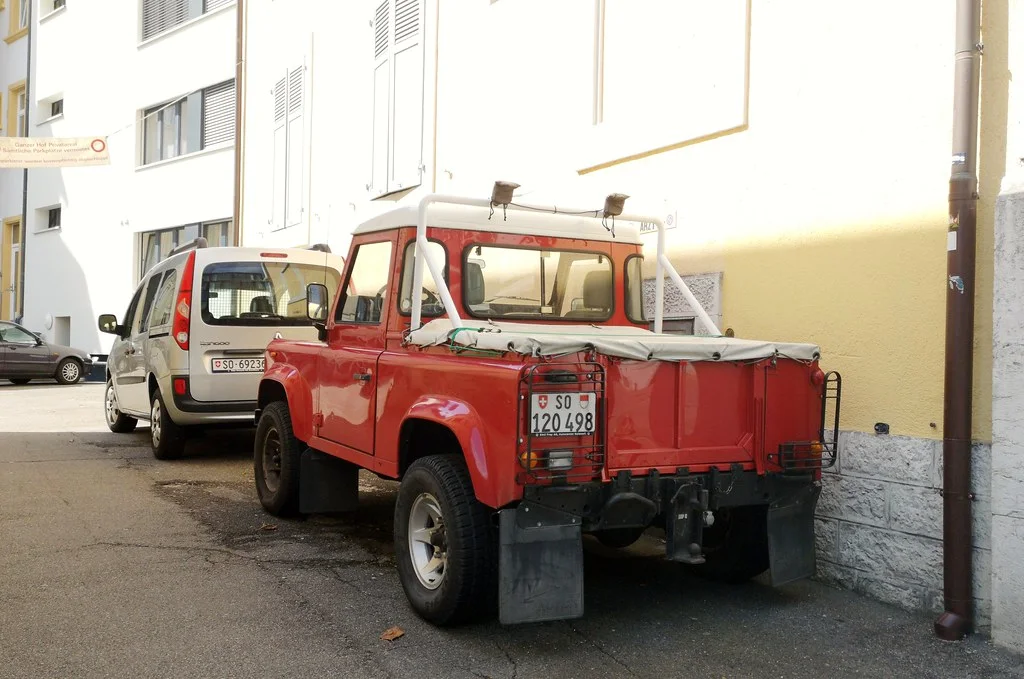
Design referenceLand Rover Defender
A vehicle whose upright body makes utility look like a visual identity.
Summary
A vehicle whose upright body makes utility look like a visual identity.
Reading status
A vehicle design reference and visual reading, not a model authentication, safety check, valuation, or mechanical assessment.
At a glance
An upright utility vehicle with squared body, exposed hinges or hardware, high stance, and simple openings.
- Design lineage
- Land Rover
- Period
- 1948 onward reference
- Materials
- Metal, glass, rubber, systems
- Setting
- Vehicle design reference
Visible evidence
Why it matters
The Defender is legible through its edges. The upright body, spare details, and practical openings say utility before the story of adventure is added.
Visible evidence
Look closer
Three details to carry with you.
- 01
Trace the vertical sides and squared roof.
- 02
Notice which hinges, handles, or fittings remain visible.
- 03
Compare the high stance with the small windows and strong door shapes.
Documented context
How it was made
Metal body panels · Glass and rubber · Mechanical systems and hardware
Documented context
Story and context
Land Rover's utility vehicle lineage began in the late 1940s and developed through changing generations and uses.
Documented context
Culture and context
Its form carries ideas of rural work, expedition, and toughness. A photograph cannot tell which of those stories belongs to one vehicle.
Documented context
Honest facts
Keeping certainty visible.
- A photo cannot verify model, year, modifications, roadworthiness, safety, condition, or ownership.
- The page avoids judging performance or value from appearance.
Interpretation
Interpretation
One way to read it.
The vehicle feels dependable because it displays the parts that make it practical.
Another reading
The visible utility can also be a costume. A work-like shape may now be used as a symbol more often than a tool.
This example follows the same order as an Art Says Hi result. Visible details come first, documented context comes next, and interpretation stays clearly marked.
Take another look
Which detail makes the vehicle feel most utilitarian: the height, hardware, windows, or squared body?
Upload a photoSources
Follow the sources, then return to the image. Some links lead to a collection or publisher website.
Image credits
Land Rover Defender Pick Up
crash71100 (opens in a new tab)CC0 1.0 (opens in a new tab)
Resized and converted to WebP for local delivery; composition otherwise unchanged.