
Art and sculpture · Discovery
Documented artworkThe Persistence of Memory
Soft clocks and hard shadows turn time into something you can almost touch.
Summary
Soft clocks and hard shadows turn time into something you can almost touch.
Reading status
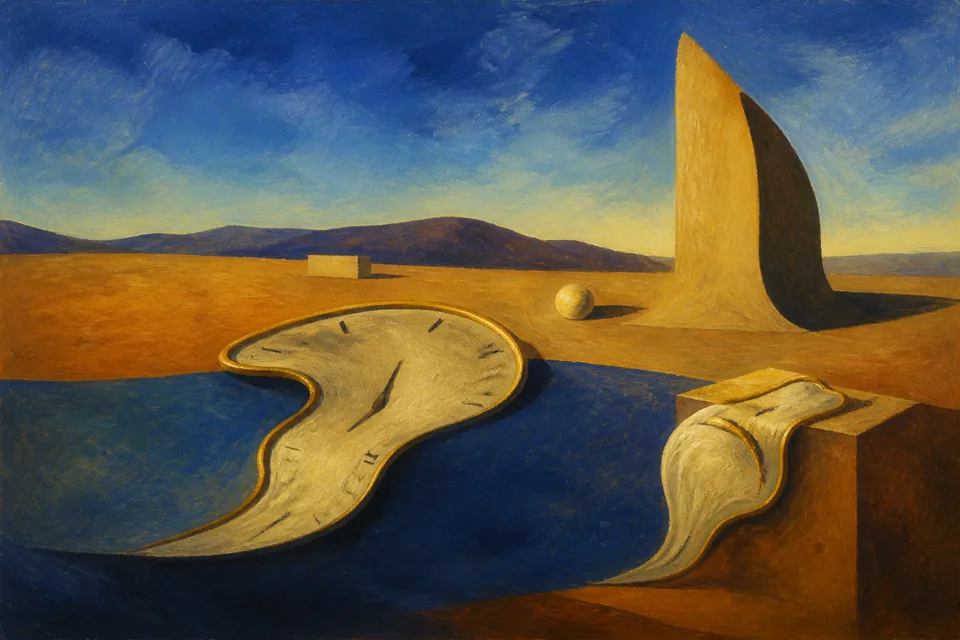
A documented painting at the Museum of Modern Art, New York. The image here is an editorial illustration in the spirit of the work, not a reproduction — check the linked MoMA and Fundació records for the painting itself.
At a glance
A small canvas where limp watches drape over a branch, a platform, and a soft central form, before a quiet coastline and a still sky.
- Made by
- Salvador Dalí
- Made
- 1931
- Medium
- Oil on canvas
- Collection
- The Museum of Modern Art, New York
Visible evidence
Why it matters
Dalí's familiar clocks are only the beginning. The quiet landscape, precise edges, and strange softness make time feel less like a measurement and more like a material that can sag, fold, or disappear.
Visible evidence
Look closer
Three details to carry with you.
- 01
Open the linked MoMA or Fundació Gala-Salvador Dalí record for the painting itself: compare the limp watches draped over a branch, a platform, and a soft central form.
- 02
The museum record describes ants covering one watch — the only swarm of life in an emptied scene, and easier to see there than in this illustration.
- 03
Notice where this editorial illustration diverges from the documented painting; it is a way into looking, not the work itself.
Documented context
How it was made
Small-scale oil on canvas · Precise linear shadows · Coastal backdrop
Documented context
Story and context
Dalí painted the work in 1931. The distant cliffs recall the Catalan coast, a landscape the artist returned to throughout his career.
Documented context
Culture and context
At only 24.1 × 33 cm the canvas is far smaller than its reputation suggests, and its melting watches have become a shorthand for Surrealism itself.
Documented context
Honest facts
Keeping certainty visible.
- The hero image is an editorial illustration, not a reproduction — brushwork, colour, and the true 24.1 × 33 cm scale can only be checked against the linked museum records.
- The museum record does not assign a single official meaning to the soft watches; readings of them, including anecdotes Dalí told later, remain interpretive.
Interpretation
Interpretation
One way to read it.
Time appears to lose its rigidity. Measurement itself seems to soften and sag while the landscape stays unnervingly still.
Another reading
The scene may be less about time breaking down than about a world emptied of anyone left to measure it.
This example follows the same order as an Art Says Hi result. Visible details come first, documented context comes next, and interpretation stays clearly marked.
Take another look
Which object feels most believable? Letting one detail appear ordinary can make the stranger details feel even more physically present.
Upload a photoSources
Follow the sources, then return to the image. Some links lead to a collection or publisher website.
Image credits
AI-generated editorial illustration for this guide (persistence-of-memory.webp)
AI-generated editorial illustration · after Salvador Dalí (opens in a new tab)Art Says Hi editorial asset (opens in a new tab)
Generated for this guide; converted to WebP for local delivery. An illustrative reference, not a reproduction of the painting.