
Designed objects · Discovery
Design referenceThonet No. 14 Chair
A bentwood chair where a few repeated curves carry an entire social history.
Summary
A bentwood chair where a few repeated curves carry an entire social history.
Reading status
A design reference and visual reading, not an authentication or structural safety check.
At a glance
A light café chair made from curved timber, a circular seat, and a small number of repeatable parts.
- Design lineage
- Michael Thonet
- Introduced
- 1859 design reference
- Materials
- Bentwood, cane, screws
- Setting
- Furniture design reference
Visible evidence
Why it matters
The No. 14 is a lesson in economy. The chair's identity is not a single ornament but the way bending, joining, and repetition make a familiar place to sit.
Visible evidence
Look closer
Three details to carry with you.
- 01
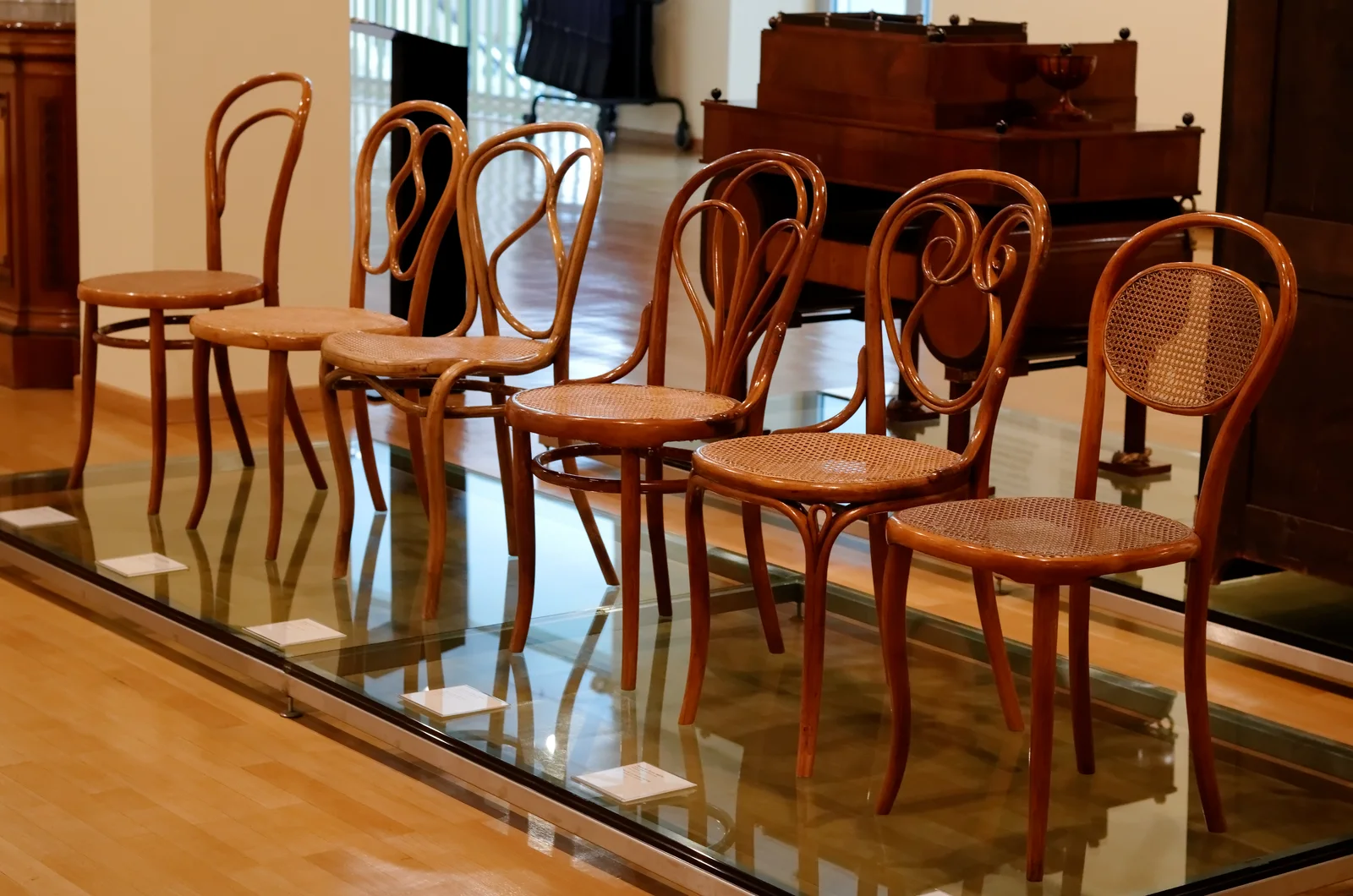
Follow the bentwood loops around the back and legs.
- 02
Compare the open space beneath the seat with the density of the joints.
- 03
Notice how the repeated chair would change a room more than one chair does.
Documented context
How it was made
Steam-bent wood · Cane seat · Standardised screws and joints
Documented context
Story and context
Thonet's nineteenth-century production methods helped make bentwood seating repeatable and transportable, changing how cafés and public interiors could be furnished.
Documented context
Culture and context
The chair is often presented as a design classic. Its wider story is about manufacturing, distribution, and the visual rhythm of a room filled with copies.
Documented context
Honest facts
Keeping certainty visible.
- The image shows a group of Thonet chairs and does not prove a specific No. 14 chair or date.
- A photo cannot assess joinery, authenticity, or structural safety.
Interpretation
Interpretation
One way to read it.
The chair feels light because its construction is a sequence of curves rather than a block of material.
Another reading
The repeated curve can also feel institutional. What reads as elegance in one chair may read as discipline when multiplied.
This example follows the same order as an Art Says Hi result. Visible details come first, documented context comes next, and interpretation stays clearly marked.
Take another look
What changes when you imagine one chair becoming twenty? Let repetition become part of the object.
Upload a photoSources
Follow the sources, then return to the image. Some links lead to a collection or publisher website.
Image credits
Thonet chairs Wien museum Karlplatz.jpg
Yelkrokoyade (opens in a new tab)CC BY-SA 3.0 (opens in a new tab)
Resized and converted to WebP for local delivery; composition otherwise unchanged.