
Guide · Photographs
How to look at a photograph
Every photograph is a set of decisions made before you arrived — the frame, the light, the crop, the print. Learn to see the decisions and the picture opens up.
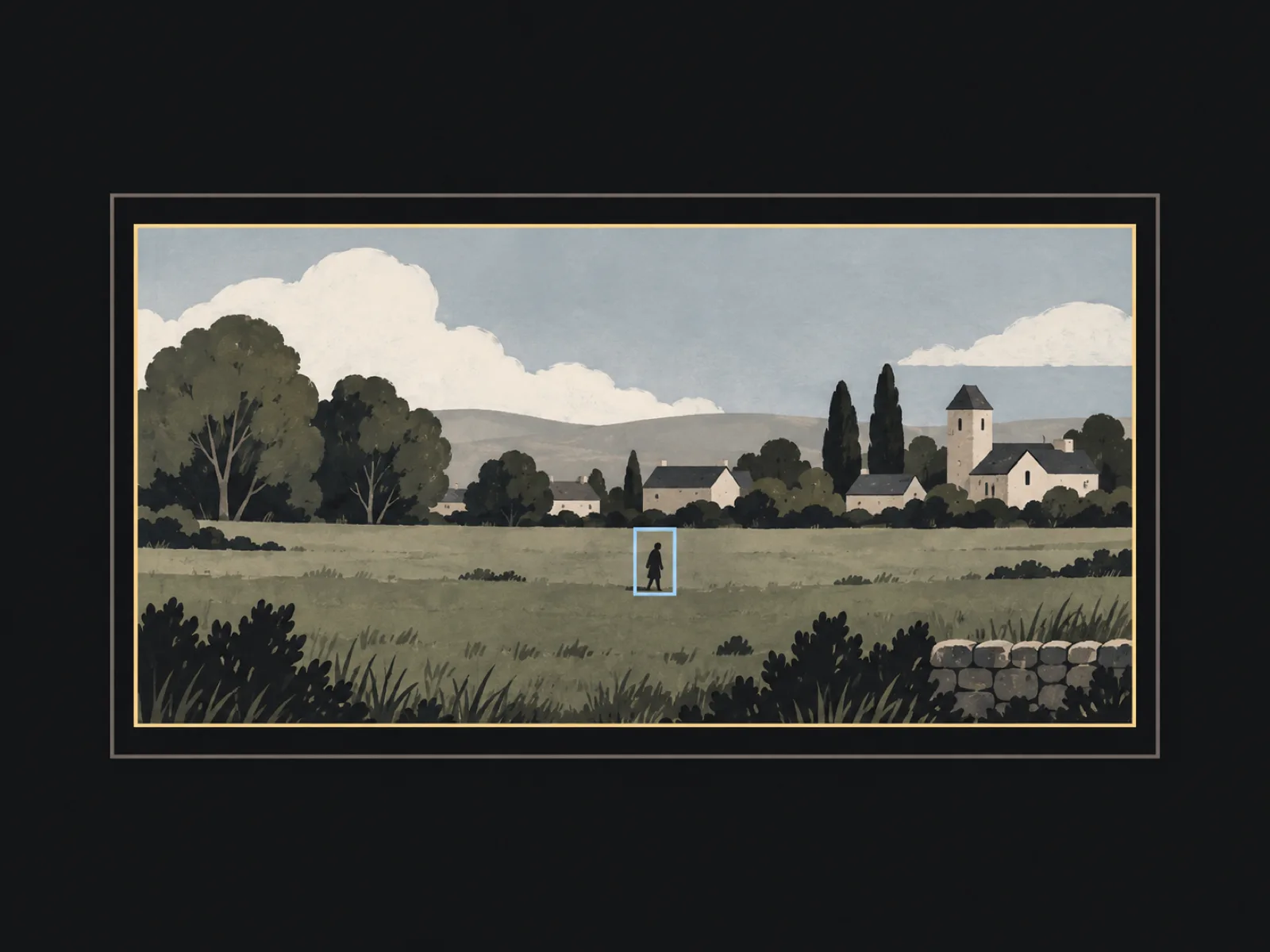
You already make photographs constantly; this guide is about reading one as a made object. The V&A has collected photographs since 1852 and now holds around 800,000 images dating from the 1820s onwards — an institution treating prints as objects worth keeping, not just pictures on screens.
The camera commits early: where the frame falls, what light it admits, what is left outside. Those decisions are the subject here — and the same habits improve the photos you feed the scanner, because a reading works on the photograph you made, not on the scene you saw. A reading is AI-generated and provisional, so the better the evidence you hand it, the more useful the draft it returns.
This is also the missing member of the site's subject-guide set — sculpture, buildings, objects, garments and posters all have their walks — and it sits deliberately opposite the photographing guide: that guide teaches you to make the photo a reading can use; this one teaches you to read the photo someone else already made.
The frame is a decision
Before any content, four edges were chosen. Ask where the photographer was standing, what the lens was allowed to include, and what the edges cut. A figure clipped by the frame tells you the crop was decisive; a wide margin of context tells you the surroundings were part of the point.
Frames also divide space into foreground, middle and distance. Note which layer carries the subject — a photograph that keeps a busy foreground around a distant figure is making a different claim from one that fills the frame with it.
And the frame is a claim about where the picture ends. Whatever continues beyond it — the street outside, the rest of the room — is the world the photographer chose not to show you.
Eye level is part of the same decision. A camera held level with a face makes one kind of photograph; one dropped to waist height or raised above a crowd makes another. Vantage is worth asking about in words: whose view is this, and from where?
Light as the subject
A photograph is recorded light before it is recorded things, so read the light first. Direction: raking light from the side models surfaces; frontal light flattens them. Hardness: sharp shadows mean a small or hard source, soft shadows a large or diffused one. Exposure: what the photographer allowed to burn out to white or sink to black is a decision, not an accident.
Shadows often carry the most legible information — their length and direction can place the sun even when the sun is out of frame. And in a great deal of photographs, light is not illuminating the subject; it is the subject.
Cropping: what got left out
Cropping happens twice — in the camera when the frame is set, and afterwards when the image is trimmed for print or page. Both edits are invisible in the finished picture, which is why the edges deserve attention: anything touching an edge was a decision about where to stop.
A tight crop concentrates attention and destroys context; a loose crop preserves context and diffuses attention. Neither is neutral. When a photograph feels off and you cannot say why, check the crop before you check the subject.
It is also worth remembering that the uncropped original existed at all — every photograph you meet has already survived one act of selection, and sometimes several: the frame, the edit, the crop for the page or the wall.
Surface and print: gloss, matte, age
A photograph is also a physical object: paper weight, borders, a gloss or matte surface, and a printing process — photogravure, gelatin silver, inkjet — that changes what the thing in your hand is. The V&A publishes an A–Z of photographic processes because the process is part of the object, not a footnote to it.
Age writes on prints too: fading, yellowed highlights, foxing spots, worn corners. A screen flattens all of this into pixels, so when you can meet the physical print, the surface is part of the work. What an aged surface records — and what later work does to it — is the subject of the repair and wear guide.
Process names repay the lookup. ‘Photogravure’ — the medium on the worked example below — means ink pulled into a sheet from an etched plate rather than silver developed in a paper: a printing process, which is also why the image can sit on a page without a darkroom.
The caption does quiet work
The record around a photograph carries the documented layer: title, maker, date, process, collection. Read a line like “photographed 1907, printed 1915” as two distinct facts — the moment captured, and the moment this particular print was made — because the gap between them is exactly the kind of thing the catalogue record guide teaches you to check.
Captions and records are the institution's current answers, and records get revised. Treat them as context to test the image against, not as the image itself.
Try it on a documented photograph
The worked example is a real public-domain photograph held by the Art Institute of Chicago: Alfred Stieglitz's The Steerage. The negative dates to 1907; the AIC's impression is a photogravure printed in 1915 — and the record states all of that in its fields. The image shows a ship's deck divided by a diagonal gangway, with passengers grouped on the levels above and below it.
Open the Art Institute of Chicago record for The Steerage (opens in a new tab) — public domain, so you are looking at the museum's own image of it — and run the five moves below. Museum education teams publish exercises like these routinely; the Smithsonian American Art Museum's education hub collects lesson plans and activities for learners of all ages.
Take the frame first. Before reading a word on the record, describe what the four edges include and what they cut. In The Steerage a diagonal gangway splits the deck — name which figures and structures sit on each side of it.
Read the light. Find the brightest passage and ask what it points at; then find where the deepest shadow falls. Note how the light treats the gangway compared with the passengers around it.
Check the record. Title, maker, date, medium are the record's words: The Steerage, Alfred Stieglitz, 1907, printed 1915, photogravure. Which of those could you not have known from the picture alone?
Notice the caption's reach. The record tells you the maker, the date, the process and the collection; the picture alone tells you none of them. That boundary — documented context versus visible evidence — is kept deliberately separate in every reading.
Then your own photo. The next photo you feed the scanner is itself a photograph with a frame, a light and a crop. Run the same moves on it first and the provisional reading it returns will have a better piece of evidence to work on.
Take another look
From here the habit transfers automatically: the next photograph that stops you — on a wall, in a book, on your own phone — you will find yourself reading its edges before its subject. And the photo you take for a reading deserves the same decisions made deliberately.
Sources
- Photographs collection (Victoria and Albert Museum) (opens in a new tab)
- Education resources (Smithsonian American Art Museum) (opens in a new tab)
- The Steerage, object record (Art Institute of Chicago) (opens in a new tab)
- Collection (Art Institute of Chicago) (opens in a new tab)
Collection details and process references follow the cited museum pages; the looking exercises are Art Says Hi editorial guidance. Sources last checked 2026-10-01.
Read a photo of your ownYour photo is only sent when you choose Start reading.
Spotted an error? Tell us